Which of the following bases would favorably deprotonate a hydroxyl group? (a)
Verified step by step guidance
1
Identify the hydroxyl group in the molecule. The hydroxyl group is characterized by an -OH functional group.
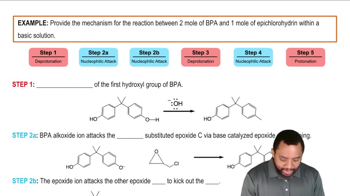
Understand the concept of deprotonation. Deprotonation involves the removal of a proton (H⁺) from the hydroxyl group, resulting in the formation of an alkoxide ion (RO⁻).
Consider the strength of the base. A strong base is required to deprotonate the hydroxyl group effectively. Organolithium compounds, such as the one shown in the image, are strong bases due to the presence of the negatively charged carbon atom.
Evaluate the ability of the base to deprotonate the hydroxyl group. The base shown in the image is an organolithium compound, which is known for its ability to deprotonate alcohols due to its high basicity.
Conclude that the organolithium compound depicted in the image is a suitable base for deprotonating a hydroxyl group, as it can effectively remove the proton from the -OH group, forming an alkoxide ion.
Verified video answer for a similar problem:
This video solution was recommended by our tutors as helpful for the problem above
Play a video:
Was this helpful?
Key Concepts
Here are the essential concepts you must grasp in order to answer the question correctly.
Deprotonation
Deprotonation is the process of removing a proton (H+) from a molecule, resulting in the formation of a conjugate base. In organic chemistry, this is often facilitated by a base, which is a substance that can accept protons. Understanding the strength and nature of the base is crucial, as stronger bases are more effective at deprotonating weak acids, such as hydroxyl groups.
A hydroxyl group (-OH) is a functional group consisting of an oxygen atom bonded to a hydrogen atom. It is characteristic of alcohols and phenols and can act as a weak acid, meaning it can donate a proton. The ability of a base to deprotonate a hydroxyl group depends on the stability of the resulting alkoxide ion and the strength of the base used.
Base strength refers to the ability of a substance to accept protons. Strong bases, such as alkoxides or hydroxides, are more effective at deprotonating hydroxyl groups compared to weak bases. The strength of a base is often determined by its position on the pKa scale, where lower pKa values indicate stronger acids and thus stronger conjugate bases.