Show how you would convert alanine to the following derivatives. Show the structure of the product in each case. (a) alanine isopropyl ester (b) N-benzoylalanine
Verified step by step guidance
1
Step 1: Understand the structure of alanine. Alanine is an amino acid with the structure CH₃-CH(NH₂)-COOH. It contains an amino group (-NH₂), a carboxylic acid group (-COOH), and a methyl group (-CH₃) as its side chain.
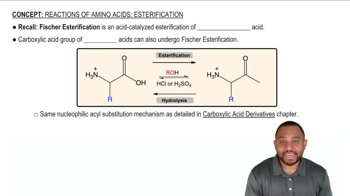
Step 2: For part (a), to convert alanine to its isopropyl ester, you need to esterify the carboxylic acid group (-COOH). This can be achieved by reacting alanine with isopropanol (CH₃-CHOH-CH₃) in the presence of an acid catalyst, such as H₂SO₄. The reaction involves the replacement of the hydroxyl group (-OH) of the carboxylic acid with the isopropyl group (-CH(CH₃)₂).
Step 3: For part (b), to convert alanine to N-benzoylalanine, you need to acylate the amino group (-NH₂) of alanine. This can be done by reacting alanine with benzoyl chloride (C₆H₅COCl) in the presence of a base, such as NaOH or pyridine. The reaction involves the formation of an amide bond between the amino group and the benzoyl group (C₆H₅CO-).
Step 4: Draw the structures of the products. For part (a), the product is alanine isopropyl ester, which has the structure CH₃-CH(NH₂)-COOCH(CH₃)₂. For part (b), the product is N-benzoylalanine, which has the structure C₆H₅CONH-CH(CH₃)-COOH.
Step 5: Verify the reaction conditions and mechanisms. Ensure that the esterification in part (a) proceeds under acidic conditions and that the acylation in part (b) occurs with the appropriate base to neutralize the HCl byproduct. This ensures the reactions proceed efficiently and yield the desired products.
Verified video answer for a similar problem:
This video solution was recommended by our tutors as helpful for the problem above
Video duration:
6m
Play a video:
Was this helpful?
Key Concepts
Here are the essential concepts you must grasp in order to answer the question correctly.
Esterification
Esterification is a chemical reaction that forms an ester from an alcohol and a carboxylic acid. In the case of converting alanine to its isopropyl ester, the hydroxyl group of the carboxylic acid (alanine) reacts with isopropanol in the presence of an acid catalyst, resulting in the formation of the ester and water. This reaction is crucial for understanding how to modify amino acids into their ester derivatives.
Reactions of Amino Acids: Esterification Concept 1
Amide Formation
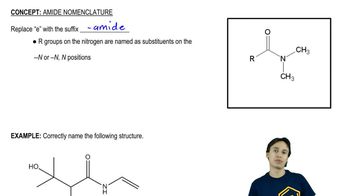
Amide formation involves the reaction between a carboxylic acid and an amine, resulting in the creation of an amide. To convert alanine to N-benzoylalanine, alanine reacts with benzoyl chloride, where the amine group of alanine attacks the carbonyl carbon of the benzoyl chloride, leading to the formation of the amide bond. This concept is essential for understanding how to create derivatives of amino acids.
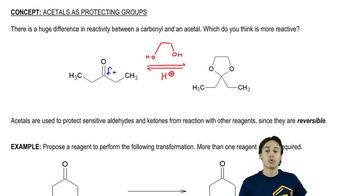
Protecting groups are temporary modifications used to shield reactive functional groups during chemical reactions. In the synthesis of derivatives like N-benzoylalanine, protecting groups may be employed to prevent unwanted reactions at the amino or carboxyl groups of alanine. Understanding how and when to use protecting groups is vital for successfully navigating complex organic syntheses.