The mechanism of the Fischer esterification was controversial until 1938, when Irving Roberts and Harold Urey of Columbia University used isotopic labeling to follow the alcohol oxygen atom through the reaction. A catalytic amount of sulfuric acid was added to a mixture of 1 mole of acetic acid and 1 mole of special methanol containing the heavy 18O isotope of oxygen. After a short period, the acid was neutralized to stop the reaction, and the components of the mixture were separated. (a) Propose a mechanism for this reaction. (b) Follow the labeled 18O atom through your mechanism, and show where it is found in the products.
Verified step by step guidance
1
Step 1: Begin by understanding the Fischer esterification mechanism. This reaction involves the acid-catalyzed reaction between a carboxylic acid and an alcohol to form an ester and water. Sulfuric acid acts as a catalyst, protonating the carboxylic acid to make it more electrophilic.
Step 2: Protonation of the acetic acid occurs first. The sulfuric acid donates a proton (H⁺) to the carbonyl oxygen of acetic acid, increasing the electrophilicity of the carbonyl carbon. This step is crucial for the nucleophilic attack by the alcohol.
Step 3: The nucleophilic alcohol (CH₃¹⁸OH) attacks the carbonyl carbon of the protonated acetic acid. This forms a tetrahedral intermediate where the labeled ¹⁸O atom from the alcohol is now attached to the carbonyl carbon.
Step 4: The tetrahedral intermediate undergoes proton transfer and elimination of water. A proton is transferred to the hydroxyl group of the intermediate, converting it into a good leaving group. Water (H₂O) is eliminated, leaving behind the ester product.
Step 5: The labeled ¹⁸O atom from the alcohol is retained in the ester product (CH₃COOCH₃). The water molecule formed in the reaction does not contain the labeled oxygen, confirming the fate of the ¹⁸O atom in the mechanism.
Verified video answer for a similar problem:
This video solution was recommended by our tutors as helpful for the problem above
Video duration:
8m
Play a video:
Was this helpful?
Key Concepts
Here are the essential concepts you must grasp in order to answer the question correctly.
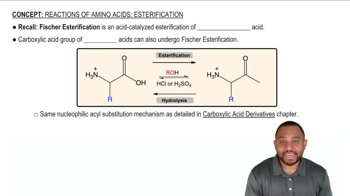
Fischer Esterification
Fischer esterification is a chemical reaction that forms an ester from a carboxylic acid and an alcohol in the presence of an acid catalyst, typically sulfuric acid. The reaction is reversible and involves the nucleophilic attack of the alcohol on the carbonyl carbon of the acid, leading to the formation of an ester and water. Understanding this mechanism is crucial for predicting the behavior of the reactants and products in the reaction.
Reactions of Amino Acids: Esterification Concept 1
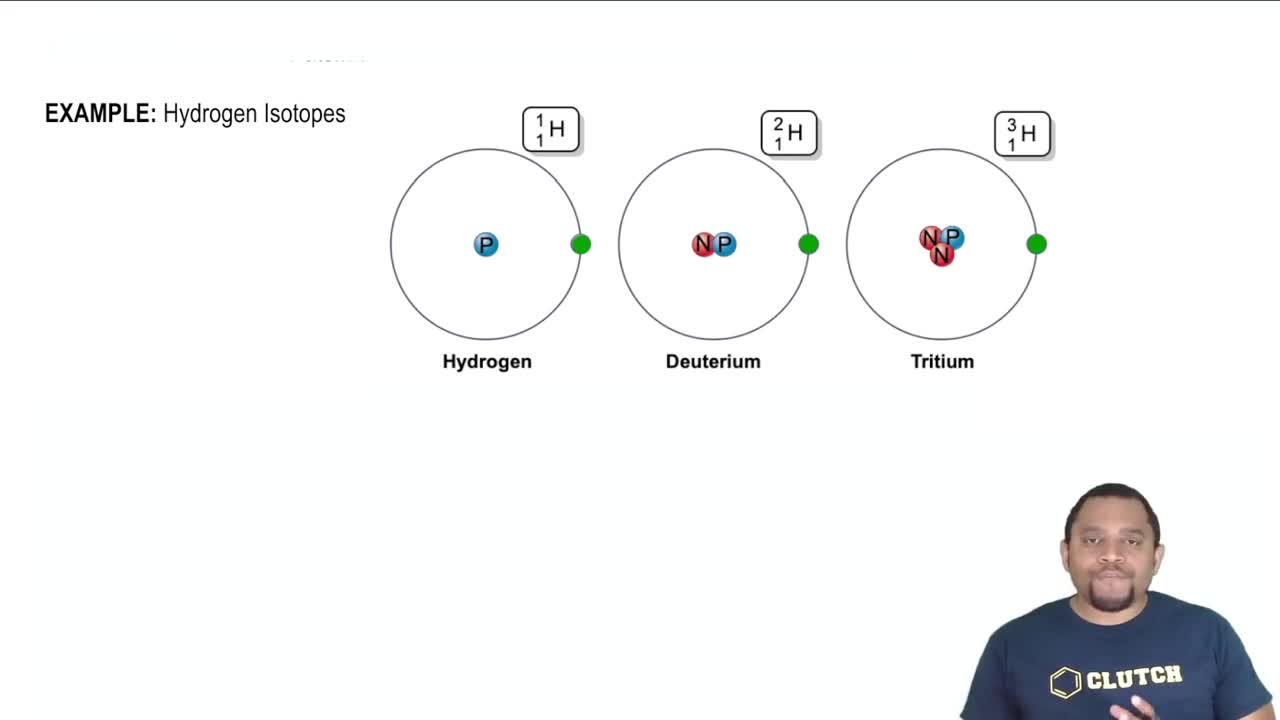
Isotopic Labeling
Isotopic labeling is a technique used in chemistry to track the movement of atoms through a reaction by substituting a stable or radioactive isotope for a more common isotope. In this case, the heavy 18O isotope is used to trace the oxygen atom from methanol through the Fischer esterification process. This method provides insights into reaction mechanisms and helps confirm the pathways taken by specific atoms during chemical transformations.
A reaction mechanism is a step-by-step description of the process by which reactants are converted into products. It outlines the individual steps, intermediates, and transition states involved in the reaction. For Fischer esterification, understanding the mechanism allows chemists to predict the outcome of the reaction, including the location of the labeled 18O atom in the final ester product, which is essential for answering the question posed.