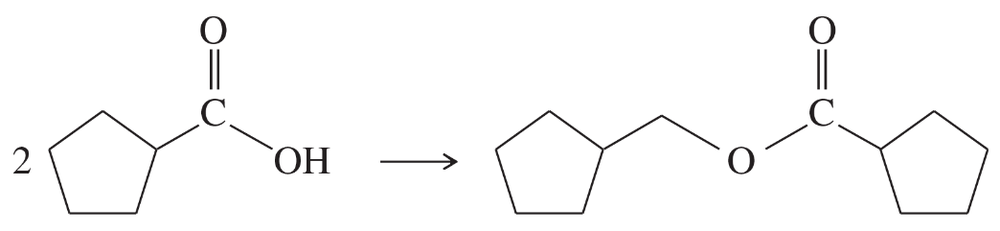
Show how you would accomplish the following multistep syntheses. You may use any additional reagents and solvents you need. (f)
Verified step by step guidance
1
Step 1: Begin with the starting material, cyclohexanecarboxylic acid. Convert the carboxylic acid group (-COOH) into an acyl chloride (-COCl) using thionyl chloride (SOCl₂). This reaction replaces the hydroxyl group (-OH) with a chlorine atom, making the compound more reactive for subsequent steps.
Step 2: Prepare the alcohol nucleophile, cyclohexanol, which will be used to form the ester bond. Ensure the alcohol is pure and ready for the esterification reaction.
Step 3: React the acyl chloride (from Step 1) with cyclohexanol in the presence of a base such as pyridine or triethylamine. The base neutralizes the HCl byproduct formed during the reaction, facilitating the formation of the ester bond.
Step 4: Allow the reaction to proceed under controlled conditions (e.g., room temperature or slightly elevated temperature) to ensure complete conversion of the acyl chloride and alcohol into the ester product.
Step 5: Purify the final product, cyclohexyl cyclohexanecarboxylate, using techniques such as distillation or recrystallization to remove any unreacted starting materials or impurities.
Verified video answer for a similar problem:
This video solution was recommended by our tutors as helpful for the problem above
Video duration:
5m
Play a video:
Was this helpful?
Key Concepts
Here are the essential concepts you must grasp in order to answer the question correctly.
Fischer Esterification
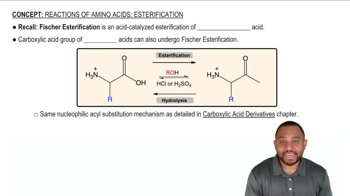
Fischer esterification is a chemical reaction that forms an ester from a carboxylic acid and an alcohol in the presence of an acid catalyst. This reaction is reversible and typically requires heating to drive the equilibrium towards ester formation. The reaction mechanism involves the protonation of the carboxylic acid, followed by nucleophilic attack by the alcohol, leading to the formation of the ester and water.
Reactions of Amino Acids: Esterification Concept 1
Reagents and Solvents
In organic synthesis, the choice of reagents and solvents is crucial for the success of a reaction. Reagents are the substances that undergo chemical changes, while solvents are the mediums in which reactions occur. For Fischer esterification, common reagents include a carboxylic acid, an alcohol, and a strong acid catalyst like sulfuric acid. The solvent can influence the reaction rate and product yield, often chosen to dissolve the reactants effectively.
Understanding the reaction mechanism is essential for predicting the outcome of a chemical reaction. In the case of Fischer esterification, the mechanism involves several steps: protonation of the carboxylic acid, nucleophilic attack by the alcohol, formation of a tetrahedral intermediate, and elimination of water to form the ester. A clear grasp of the mechanism helps in optimizing conditions and selecting appropriate reagents for the synthesis.