Show how each of the following compounds can be prepared, using the given starting material: a.
Verified step by step guidance
1
Step 1: Analyze the starting material and the target compound. The starting material is acetaldehyde (CH3CHO), and the target compound is methyl acetate (CH3COOCH3). This transformation involves converting an aldehyde into an ester.
Step 2: Recognize the reaction type. This transformation can be achieved through nucleophilic acyl substitution, where the aldehyde is first oxidized to a carboxylic acid and then converted into an ester using an alcohol and an acid catalyst.
Step 3: Oxidize the aldehyde to a carboxylic acid. Use an oxidizing agent such as potassium permanganate (KMnO4) or chromium-based reagents (e.g., CrO3 or K2Cr2O7) to convert acetaldehyde into acetic acid (CH3COOH).
Step 4: Perform esterification. React the acetic acid with methanol (CH3OH) in the presence of an acid catalyst, such as sulfuric acid (H2SO4), to form methyl acetate. This is a Fischer esterification reaction.
Step 5: Purify the product. After the reaction, isolate methyl acetate by distillation or extraction, ensuring the removal of any unreacted starting materials or by-products.
Verified video answer for a similar problem:
This video solution was recommended by our tutors as helpful for the problem above
Video duration:
2m
Play a video:
Was this helpful?
Key Concepts
Here are the essential concepts you must grasp in order to answer the question correctly.
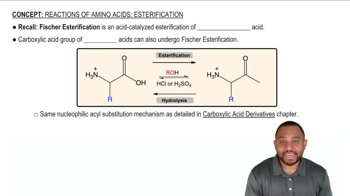
Fischer Esterification
Fischer esterification is a chemical reaction that forms an ester from a carboxylic acid and an alcohol in the presence of an acid catalyst. The reaction involves the nucleophilic attack of the alcohol on the carbonyl carbon of the carboxylic acid, leading to the formation of an ester and water. This process is reversible, and the equilibrium can be shifted by removing water or using excess reactants.
Reactions of Amino Acids: Esterification Concept 1
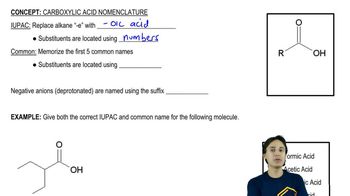
Carboxylic Acids
Carboxylic acids are organic compounds characterized by the presence of a carboxyl group (-COOH). They are known for their acidic properties due to the ability to donate a proton (H+) in solution. Carboxylic acids can be derived from various sources, including the oxidation of alcohols, and they serve as important starting materials in organic synthesis, particularly in esterification reactions.
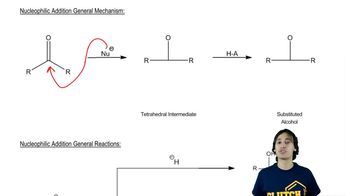
Nucleophilic attack is a fundamental concept in organic chemistry where a nucleophile, which is an electron-rich species, attacks an electron-deficient atom, typically a carbon atom in a carbonyl group. In the context of Fischer esterification, the alcohol acts as the nucleophile, attacking the carbonyl carbon of the carboxylic acid, leading to the formation of a tetrahedral intermediate that eventually results in ester formation.