In which step(s) of the hydride reduction of an ester does the compound undergo reduction? (Hint: Count the bonds to oxygen.)
Verified step by step guidance
1
Step 1: Understand the hydride reduction of an ester. This reaction typically involves the use of a reducing agent like lithium aluminum hydride (LiAlH₄) to convert the ester into an alcohol. The process occurs in multiple steps.
Step 2: Recall the definition of reduction in organic chemistry. Reduction involves a decrease in the number of bonds to oxygen or an increase in the number of bonds to hydrogen in a molecule.
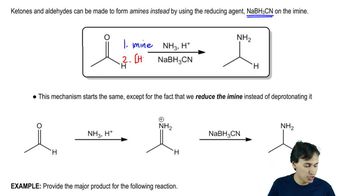
Step 3: Analyze the first step of the reaction. The hydride ion (H⁻) from the reducing agent attacks the carbonyl carbon of the ester, breaking the π bond of the carbonyl group and forming a tetrahedral intermediate. At this stage, the carbonyl carbon gains a bond to hydrogen, which is a reduction step.
Step 4: Examine the second step of the reaction. The tetrahedral intermediate collapses, expelling the leaving group (usually an alkoxide ion, R'O⁻) and forming an aldehyde. This step does not involve a change in the number of bonds to oxygen for the carbonyl carbon, so it is not a reduction step.
Step 5: Consider the final step. The aldehyde undergoes a second hydride attack, forming a new tetrahedral intermediate that eventually becomes a primary alcohol. In this step, the carbonyl carbon again gains a bond to hydrogen, making it another reduction step.
Verified video answer for a similar problem:
This video solution was recommended by our tutors as helpful for the problem above
Video duration:
4m
Play a video:
Was this helpful?
Key Concepts
Here are the essential concepts you must grasp in order to answer the question correctly.
Hydride Reduction
Hydride reduction is a chemical reaction where a hydride ion (H-) is used to reduce a carbonyl compound, such as an ester, to an alcohol. This process typically involves the transfer of a hydride from a reducing agent, like lithium aluminum hydride (LiAlH4) or sodium borohydride (NaBH4), to the carbonyl carbon, resulting in the formation of an alcohol and the conversion of the carbonyl group.
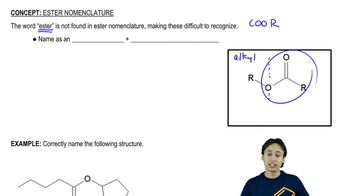
Esters are organic compounds characterized by the functional group -COOR, where R is an alkyl or aryl group. In the context of reduction, understanding the structure of esters is crucial, as they contain a carbonyl group (C=O) and an alkoxy group (–O–R). The reduction process involves the conversion of the carbonyl group to an alcohol, which requires counting the bonds to oxygen to determine the extent of reduction.
In organic chemistry, bond counting is a method used to assess the degree of reduction or oxidation of a compound. For esters undergoing hydride reduction, it is essential to count the bonds to oxygen before and after the reaction. The reduction of the carbonyl group (C=O) to an alcohol (C–OH) involves a change from one double bond to one single bond and the addition of a hydrogen atom, indicating a reduction in oxidation state.