An unknown alcohol with a molecular formula of C7H14O was oxidized to an aldehyde with HOCl. When an acidic solution of the alcohol was distilled, two alkenes were obtained. The alkene formed in greater yield was determined to be 1-methylcyclohexene. The other alkene formed the original un-known alcohol when treated with BH3/THF followed by H2O2, HO-, and H2O. Identify the unknown alcohol.
Verified step by step guidance
1
Step 1: Analyze the molecular formula C7H14O. This indicates the compound is an alcohol with one oxygen atom and a degree of unsaturation. Calculate the degree of unsaturation using the formula: \( ext{Degree of Unsaturation} = rac{2C + 2 - H}{2} \). For C7H14O, \( ext{Degree of Unsaturation} = rac{2(7) + 2 - 14}{2} = 1 \), suggesting one ring or one double bond.
Step 2: Consider the oxidation reaction with HOCl. Alcohols oxidized to aldehydes are typically primary alcohols. This suggests the unknown alcohol is a primary alcohol.
Step 3: Examine the elimination reaction under acidic distillation conditions. Two alkenes are formed, with 1-methylcyclohexene being the major product. This indicates the alcohol is cyclohexane-based and undergoes dehydration to form alkenes. The major product suggests the alcohol has a substituent at the 1-position, favoring the formation of 1-methylcyclohexene.
Step 4: Analyze the minor alkene product. When treated with BH3/THF followed by \( ext{H}_2 ext{O}_2, ext{HO}^- \), and \( ext{H}_2 ext{O} \), the minor alkene regenerates the original alcohol. This indicates the minor alkene is formed via elimination from the same alcohol and retains the structural features necessary to revert back to the alcohol.
Step 5: Combine all observations. The alcohol must be a cyclohexane derivative with a methyl group at the 1-position and a hydroxyl group at another position that allows for oxidation to an aldehyde and elimination to form the observed alkenes. Based on the data, the unknown alcohol is likely 1-methylcyclohexanol.
Verified video answer for a similar problem:
This video solution was recommended by our tutors as helpful for the problem above
Video duration:
13m
Play a video:
Was this helpful?
Key Concepts
Here are the essential concepts you must grasp in order to answer the question correctly.
Oxidation of Alcohols
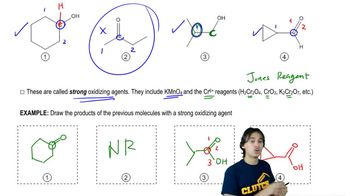
Oxidation of alcohols involves the conversion of alcohols into carbonyl compounds, such as aldehydes or ketones, through the removal of hydrogen or the addition of oxygen. In this case, the unknown alcohol (C7H14O) is oxidized to an aldehyde using HOCl, which is a common oxidizing agent. Understanding the oxidation process is crucial for identifying the structure of the original alcohol based on the products formed.
The distillation of an acidic solution of alcohol can lead to the formation of alkenes through dehydration reactions. In this scenario, two alkenes were produced, with 1-methylcyclohexene being the major product. Recognizing the mechanism of dehydration and the stability of the resulting alkenes helps in deducing the structure of the original alcohol based on the alkenes formed.
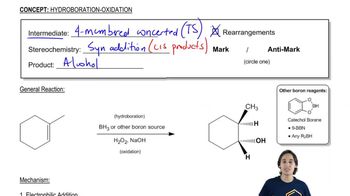
The hydroboration-oxidation reaction is a two-step process that converts alkenes into alcohols. In this case, the alkene that was formed in lesser yield, when treated with BH3/THF followed by H2O2, HO-, and H2O, regenerates the original unknown alcohol. This reaction is significant for understanding the relationship between the alkenes and the original alcohol, aiding in its identification.