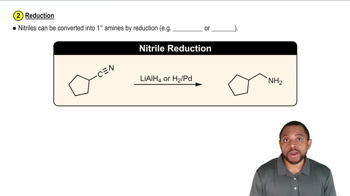
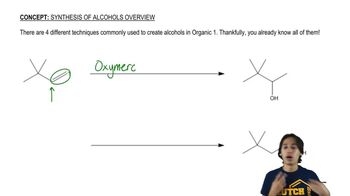
Compounds containing deuterium (D = 2H) are useful for kinetic studies and metabolic studies with new pharmaceuticals. One way to introduce deuterium is by using the reagent LiAlD4, equivalent in reactivity to LiAlH4. Show how to make these deuterium-labeled compounds, using LiAlD4 and D2O as your sources of deuterium, and any non-deuterated starting materials you wish. (b) CH3CD2OH
Verified step by step guidance
1
Step 1: Understand the problem. The goal is to synthesize CH3CD2OH, a deuterium-labeled alcohol, using LiAlD4 and D2O as sources of deuterium. LiAlD4 is a reducing agent that introduces deuterium (D) in place of hydrogen (H), and D2O can be used to exchange hydrogen atoms with deuterium.
Step 2: Select a suitable non-deuterated starting material. For this synthesis, you can start with CH3CHO (acetaldehyde), which contains a carbonyl group that can be reduced to an alcohol.
Step 3: Use LiAlD4 to reduce the carbonyl group in CH3CHO. The hydride (H-) equivalent in LiAlD4 is replaced by deuteride (D-), so the reduction will introduce deuterium atoms into the molecule. The reaction will convert CH3CHO into CH3CD2OH.
Step 4: If additional deuterium incorporation is needed, treat the product (CH3CD2OH) with D2O under acidic or basic conditions. This step allows for exchange of any remaining hydrogen atoms with deuterium from D2O.
Step 5: Verify the structure of the final product, CH3CD2OH, ensuring that the deuterium atoms are correctly incorporated at the desired positions. This can be confirmed using spectroscopic techniques such as NMR (nuclear magnetic resonance).
Verified video answer for a similar problem:
This video solution was recommended by our tutors as helpful for the problem above
Video duration:
3m
Play a video:
Was this helpful?
Key Concepts
Here are the essential concepts you must grasp in order to answer the question correctly.
Deuterium and Its Applications
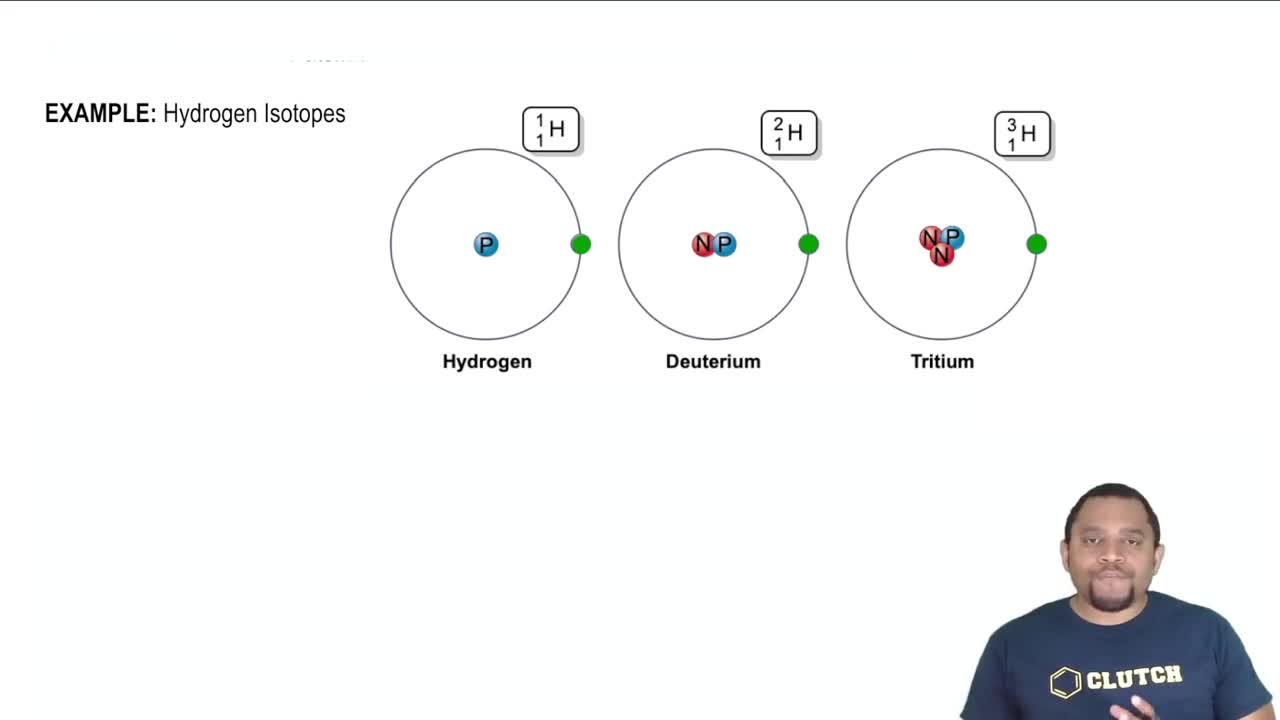
Deuterium is a stable isotope of hydrogen, represented as D or 2H, which contains one proton and one neutron. Its unique properties make it valuable in kinetic and metabolic studies, particularly in pharmaceuticals, as it can help trace reaction pathways and metabolic processes without altering the chemical behavior of the compounds.
LiAlD4 is a powerful reducing agent similar to LiAlH4 but specifically used for introducing deuterium into organic compounds. It reacts with various functional groups, facilitating the substitution of hydrogen atoms with deuterium, which is essential for synthesizing deuterium-labeled compounds for research purposes.
The synthesis of deuterated alcohols, such as CH3CD2OH, involves the reaction of non-deuterated starting materials with deuterium sources like LiAlD4 and D2O. This process typically includes reduction reactions where deuterium replaces hydrogen in the alcohol structure, allowing for the creation of compounds that can be used in various analytical studies.