Show how you would convert 2-methylcyclopentanol to the following products. Any of these products may be used as the reactant in any subsequent part of this problem. a. 1-methylcyclopentene b. 2-methylcyclopentyl tosylate c. 2-methylcyclopentanone
Verified step by step guidance
1
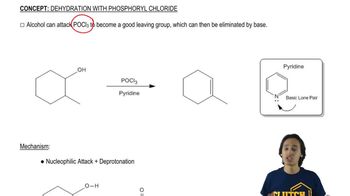
Step 1: To convert 2-methylcyclopentanol to 1-methylcyclopentene (product a), perform an acid-catalyzed dehydration reaction. Use a strong acid like H₂SO₄ or H₃PO₄ to protonate the hydroxyl group, creating a good leaving group (water). Then, the carbocation intermediate undergoes rearrangement to form the more stable tertiary carbocation, followed by elimination of a proton to yield the alkene.
Step 2: To convert 2-methylcyclopentanol to 2-methylcyclopentyl tosylate (product b), react the alcohol with p-toluenesulfonyl chloride (TsCl) in the presence of a base like pyridine. This reaction replaces the hydroxyl group with a tosyl group (-OTs), creating a good leaving group for subsequent substitution or elimination reactions.
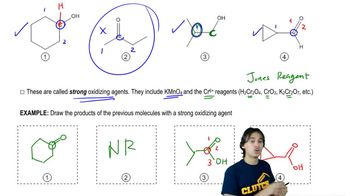
Step 3: To convert 2-methylcyclopentanol to 2-methylcyclopentanone (product c), perform an oxidation reaction. Use an oxidizing agent such as PCC (pyridinium chlorochromate) or Jones reagent (CrO₃/H₂SO₄) to oxidize the secondary alcohol to a ketone. Ensure mild conditions to avoid overoxidation.
Step 4: Recognize that any of the products (a, b, or c) can be used as reactants for further transformations. For example, 1-methylcyclopentene can undergo hydroboration-oxidation to form an alcohol, or 2-methylcyclopentyl tosylate can undergo nucleophilic substitution to introduce new functional groups.
Step 5: Carefully analyze the reaction conditions and mechanisms for each transformation to ensure proper stereochemistry and regioselectivity, especially in cases involving carbocation rearrangements or oxidation reactions.
Verified video answer for a similar problem:
This video solution was recommended by our tutors as helpful for the problem above
Video duration:
6m
Play a video:
Was this helpful?
Key Concepts
Here are the essential concepts you must grasp in order to answer the question correctly.
Alcohol Dehydration
Alcohol dehydration is a key reaction in organic chemistry where an alcohol is converted into an alkene through the elimination of water. In the case of converting 2-methylcyclopentanol to 1-methylcyclopentene, this process typically involves heating the alcohol with an acid catalyst, leading to the formation of a double bond and the release of water.
Nucleophilic substitution is a fundamental reaction mechanism in organic chemistry where a nucleophile replaces a leaving group in a molecule. For the conversion of 2-methylcyclopentanol to 2-methylcyclopentyl tosylate, the hydroxyl group of the alcohol is converted into a better leaving group (tosylate) through reaction with tosyl chloride, facilitating subsequent nucleophilic attack.
Nucleophiles and Electrophiles can react in Substitution Reactions.
Oxidation of Alcohols
The oxidation of alcohols is a process where alcohols are converted into carbonyl compounds, such as ketones or aldehydes, by the addition of oxidizing agents. To convert 2-methylcyclopentanol to 2-methylcyclopentanone, an oxidizing agent like chromic acid or PCC can be used to facilitate the transformation, resulting in the formation of a ketone.