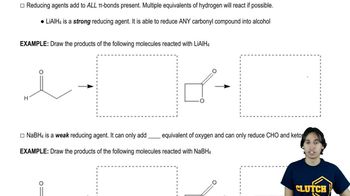
What products are obtained from the reaction of the following compounds with LiAlH4 followed by treatment with dilute acid? c. methyl benzoate d. pentanoic acid
Verified step by step guidance
1
Step 1: Understand the role of LiAlH4 (Lithium Aluminum Hydride). LiAlH4 is a strong reducing agent commonly used to reduce esters, carboxylic acids, aldehydes, and ketones to their corresponding alcohols. The reaction typically involves two steps: reduction with LiAlH4 and subsequent hydrolysis with dilute acid to complete the reaction.
Step 2: Analyze the structure of methyl benzoate. Methyl benzoate is an ester with the formula C6H5COOCH3. When treated with LiAlH4, the ester bond is reduced to form two alcohols: the alcohol derived from the carboxylic acid portion (benzyl alcohol, C6H5CH2OH) and the alcohol derived from the alkyl group (methanol, CH3OH).
Step 3: Analyze the structure of pentanoic acid. Pentanoic acid is a carboxylic acid with the formula CH3(CH2)3COOH. When treated with LiAlH4, the carboxylic acid group (-COOH) is reduced to a primary alcohol (-CH2OH). The product is 1-pentanol (CH3(CH2)3CH2OH).
Step 4: Perform the hydrolysis step. After the reduction with LiAlH4, the reaction mixture is treated with dilute acid (e.g., H3O+). This step ensures the protonation of the oxygen atoms and completes the formation of the alcohol products.
Step 5: Summarize the products. For methyl benzoate, the products are benzyl alcohol (C6H5CH2OH) and methanol (CH3OH). For pentanoic acid, the product is 1-pentanol (CH3(CH2)3CH2OH).
Verified video answer for a similar problem:
This video solution was recommended by our tutors as helpful for the problem above
Video duration:
4m
Play a video:
Was this helpful?
Key Concepts
Here are the essential concepts you must grasp in order to answer the question correctly.
Reduction Reactions
Reduction reactions involve the gain of electrons or the decrease in oxidation state of a molecule. In organic chemistry, this often refers to the conversion of carbonyl compounds (like esters and carboxylic acids) to alcohols. Lithium aluminum hydride (LiAlH4) is a strong reducing agent that can effectively reduce esters and acids to their corresponding alcohols.
Lithium aluminum hydride (LiAlH4) is a powerful reducing agent used in organic synthesis. It can reduce a variety of functional groups, including esters, carboxylic acids, and aldehydes, to alcohols. The reaction typically requires anhydrous conditions, and after reduction, the addition of dilute acid is necessary to protonate the alkoxide intermediate formed during the reaction.
An acid-base workup is a common procedure following a reduction reaction to neutralize any remaining reducing agent and to protonate the alkoxide intermediates. In this context, treating the reaction mixture with dilute acid after the reduction with LiAlH4 converts the alkoxide into the corresponding alcohol, facilitating the isolation of the desired product.


 4:07 minutes
 Verified step by step guidance
 07:12
07:12