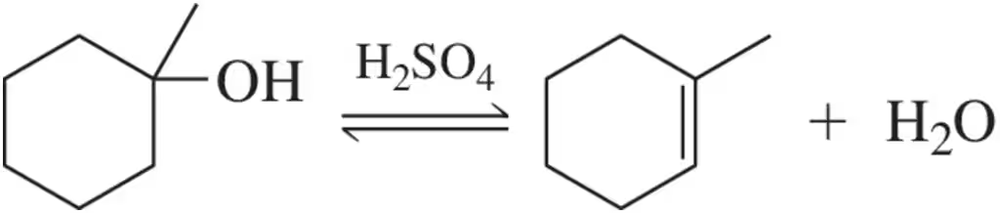
The acid-catalyzed hydration we learned here in Chapter 8 is reversible: (e) How might you shift the equilibrium to the left?
Verified step by step guidance
1
Understand the acid-catalyzed hydration reaction: This reaction involves the addition of water (H₂O) to an alkene in the presence of an acid catalyst, forming an alcohol. The reaction is reversible, meaning the alcohol can revert back to the alkene and water under certain conditions.
Recall Le Chatelier's Principle: This principle states that if a dynamic equilibrium is disturbed by changing the conditions, the system will adjust to counteract the disturbance and restore equilibrium. To shift the equilibrium to the left (favoring the formation of the alkene and water), you need to manipulate the reaction conditions.
Decrease the concentration of water: Since water is a reactant in the forward reaction, reducing its concentration will drive the equilibrium toward the reactants (alkene and water). This can be achieved by removing water from the reaction mixture or using a drying agent.
Increase the concentration of the alcohol: Adding more alcohol to the system will push the equilibrium toward the reactants (alkene and water), as the system tries to counteract the increase in alcohol concentration.
Change the temperature: Acid-catalyzed hydration is typically exothermic in the forward direction. Lowering the temperature can favor the reverse reaction (formation of alkene and water), as the system compensates for the removal of heat.
Verified video answer for a similar problem:
This video solution was recommended by our tutors as helpful for the problem above
Video duration:
2m
Play a video:
Was this helpful?
Key Concepts
Here are the essential concepts you must grasp in order to answer the question correctly.
Le Chatelier's Principle
Le Chatelier's Principle states that if a dynamic equilibrium is disturbed by changing the conditions, the position of equilibrium shifts to counteract the change. In the context of acid-catalyzed hydration, altering concentration, temperature, or pressure can influence the direction of the reaction, allowing us to predict how to shift the equilibrium to favor either the reactants or products.
Acid-catalyzed hydration is a reaction where an alkene reacts with water in the presence of an acid to form an alcohol. This process involves the formation of a carbocation intermediate and is reversible, meaning that the products can revert back to the reactants under certain conditions. Understanding this reaction is crucial for manipulating the equilibrium.
The equilibrium constant (K) quantifies the ratio of the concentrations of products to reactants at equilibrium for a reversible reaction. A change in concentration of either reactants or products will affect the value of K, thus shifting the equilibrium position. By manipulating concentrations, one can effectively shift the equilibrium to the left, favoring the formation of reactants.