
Textbook Question
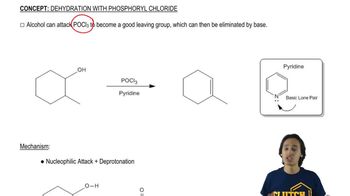
Show the product(s) you expect from dehydration of the following alcohols when they are heated in sulfuric or phosphoric acid. In each case, use a mechanism to show how the products are formed.
(c)
697
views


 Verified step by step guidance
 01:23
01:23
 09:36
09:36 01:18
01:18Show the product(s) you expect from dehydration of the following alcohols when they are heated in sulfuric or phosphoric acid. In each case, use a mechanism to show how the products are formed.
(c)
The dehydrogenation of butane to trans-but-2-ene has ΔH° = +116 kJ/mol (+27.6 kcal/mol) and ΔS° = +117J/kelvin-mol (+28.0 cal/kelvin-mol).
a. Compute the value of ΔG° for dehydrogenation at room temperature (25 °C or 298 °K). Is dehydrogenation favored or disfavored?
HINT: When you are doing synthesis problems, avoid using these high-temperature industrial methods. They require specialized equipment, and they produce variable mixtures of products.
Propose mechanisms for the following reactions.
(d)
Propose mechanisms for the following reactions.
(c)
For practice in recognizing mechanisms, classify each reaction according to the type of mechanism you expect:
1. Free-radical chain reaction
2. Reaction involving strong bases and strong nucleophiles
3. Reaction involving strong acids and strong electrophiles
(a)
Show the product(s) you expect from dehydration of the following alcohols when they are heated in sulfuric or phosphoric acid. In each case, use a mechanism to show how the products are formed.
(a)