Draw a mechanism for the acidic hydrolysis of the magnesium salt shown below to acetophenone.
Verified step by step guidance
1
Step 1: Identify the magnesium salt structure. The compound shown is a magnesium salt of an imine, where the nitrogen is bonded to magnesium iodide (MgI). The carbon-nitrogen double bond is polarized, with the nitrogen carrying a lone pair and partial negative charge.
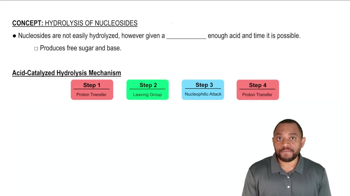
Step 2: Protonation of the imine nitrogen. In acidic conditions, a proton (H⁺) from the acid will attack the lone pair on the nitrogen, leading to the formation of a positively charged iminium ion. This step increases the electrophilicity of the carbon atom in the C=N bond.
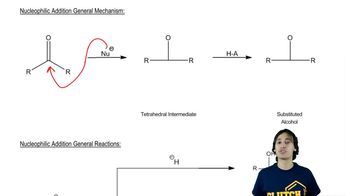
Step 3: Nucleophilic attack by water. Water, acting as a nucleophile, attacks the electrophilic carbon atom of the iminium ion. This results in the formation of a tetrahedral intermediate, where the carbon is bonded to both the nitrogen and a hydroxyl group.
Step 4: Elimination of the nitrogen group. The tetrahedral intermediate undergoes rearrangement, leading to the cleavage of the C-N bond. The nitrogen group is eliminated as ammonia (NH₃), and the carbon is left with a hydroxyl group.
Step 5: Formation of acetophenone. The hydroxyl group on the carbon undergoes tautomerization or dehydration, depending on the reaction conditions, to form the final product, acetophenone (C₆H₅COCH₃).
Verified video answer for a similar problem:
This video solution was recommended by our tutors as helpful for the problem above
Video duration:
7m
Play a video:
Was this helpful?
Key Concepts
Here are the essential concepts you must grasp in order to answer the question correctly.
Acidic Hydrolysis
Acidic hydrolysis is a chemical reaction where a compound reacts with water in the presence of an acid, leading to the cleavage of bonds and the formation of new products. In this context, the magnesium salt undergoes hydrolysis to yield acetophenone, facilitated by the protonation of the imine nitrogen, which enhances its electrophilicity and promotes nucleophilic attack by water.
The mechanism of nucleophilic attack involves the interaction of a nucleophile with an electrophile, resulting in the formation of a new bond. In the case of the magnesium salt, water acts as the nucleophile, attacking the carbon atom of the imine group after the nitrogen is protonated, leading to the formation of an intermediate that eventually rearranges to produce acetophenone.
The magnesium salt in this reaction serves as a Lewis acid, facilitating the hydrolysis process. It stabilizes the imine structure and enhances the electrophilic character of the carbon-nitrogen double bond, making it more susceptible to nucleophilic attack by water. This role is crucial for the successful conversion of the magnesium salt to acetophenone.