Textbook Question
For each molecule shown below,
1. indicate the most acidic hydrogens.
2. draw the important resonance contributors of the anion that results from removal of the most acidic hydrogen.
(h)
579
views

 Wade 9th EditionCh. 22 - Condensations and Alpha Substitutions of Carbonyl CompoundsProblem 61(1)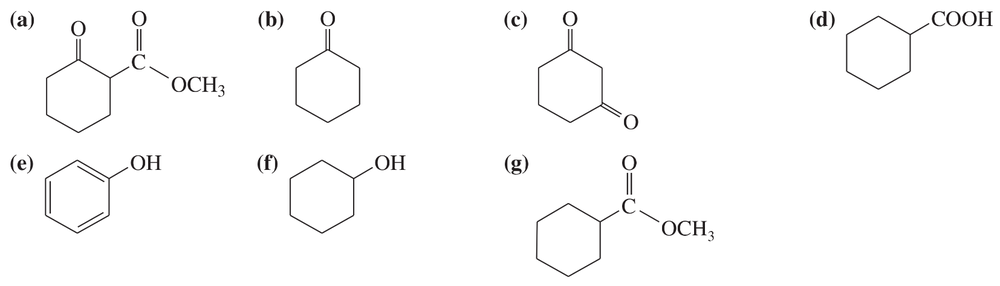
 Verified step by step guidance
 07:45
07:45
 03:43
03:43 01:47
01:47For each molecule shown below,
1. indicate the most acidic hydrogens.
2. draw the important resonance contributors of the anion that results from removal of the most acidic hydrogen.
(h)
For each molecule shown below,
1. indicate the most acidic hydrogens.
2. draw the important resonance contributors of the anion that results from removal of the most acidic hydrogen.
(e)
Predict the products of the following aldol condensations. Show the products both before and after dehydration.
(a)
2. Indicate which compounds would be more than 99% deprotonated by a solution of sodium ethoxide in ethanol.
Predict the products of the following aldol condensations. Show the products both before and after dehydration.
(b)
For each molecule shown below,
1. indicate the most acidic hydrogens.
2. draw the important resonance contributors of the anion that results from removal of the most acidic hydrogen.
(g)