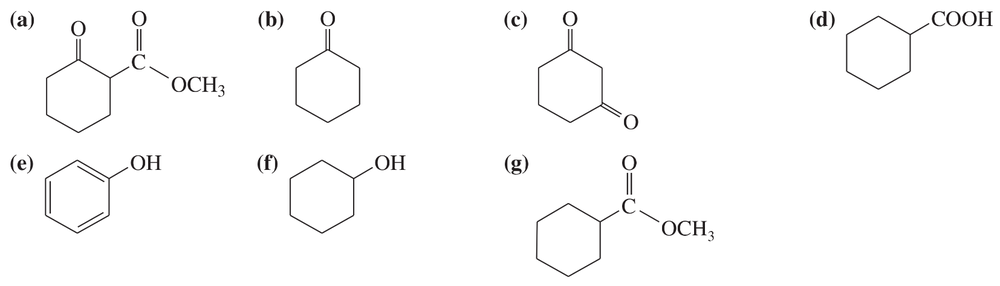
2. Indicate which compounds would be more than 99% deprotonated by a solution of sodium ethoxide in ethanol.
Verified step by step guidance
1
Step 1: Understand the problem. Sodium ethoxide in ethanol is a strong base, and it will deprotonate compounds with acidic protons. The acidity of a proton is determined by the stability of the conjugate base formed after deprotonation. Look for functional groups such as carboxylic acids, phenols, and alpha-hydrogens adjacent to carbonyl groups.
Step 2: Analyze each compound. For compound I, it contains alpha-hydrogens adjacent to two carbonyl groups. These hydrogens are acidic due to resonance stabilization of the enolate ion formed after deprotonation.
Step 3: For compound II, it has alpha-hydrogens adjacent to a single carbonyl group. These hydrogens are less acidic compared to compound I but can still be deprotonated by sodium ethoxide.
Step 4: For compound IV, it contains a carboxylic acid group. The proton on the hydroxyl group of the carboxylic acid is highly acidic and will be deprotonated by sodium ethoxide.
Step 5: For compound V, it contains a phenol group. The hydroxyl proton is acidic due to resonance stabilization of the phenoxide ion formed after deprotonation. This proton will also be deprotonated by sodium ethoxide.
Verified video answer for a similar problem:
This video solution was recommended by our tutors as helpful for the problem above
Video duration:
7m
Play a video:
Was this helpful?
Key Concepts
Here are the essential concepts you must grasp in order to answer the question correctly.
Deprotonation
Deprotonation is the removal of a proton (H+) from a molecule, resulting in the formation of a conjugate base. This process is crucial in organic chemistry, particularly in reactions involving acids and bases. The strength of the base used for deprotonation, such as sodium ethoxide, determines which compounds will be effectively deprotonated. Compounds with acidic protons, such as those adjacent to electronegative atoms or in resonance-stabilized structures, are more likely to undergo deprotonation.
Acidity is a measure of how easily a compound can donate a proton, quantified by its pKa value. Lower pKa values indicate stronger acids, which are more likely to be deprotonated in the presence of a strong base like sodium ethoxide. Understanding the pKa of the compounds in the question is essential for predicting which will be more than 99% deprotonated. Compounds with functional groups such as carboxylic acids or phenols typically have lower pKa values and are more acidic.
Resonance stabilization occurs when a molecule can be represented by multiple valid Lewis structures, allowing for the delocalization of electrons. This delocalization can stabilize the negative charge that results from deprotonation, making the conjugate base more stable. Compounds that can stabilize the negative charge through resonance are more likely to be deprotonated by a strong base. Identifying resonance structures in the given compounds will help determine their likelihood of deprotonation.