
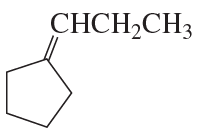
What carbonyl compound and what phosphonium ylide are needed to synthesize the following compounds? b.
Verified step by step guidance
1
Step 1: Identify the target compound's structure. The given compound contains a double bond, indicating it is likely synthesized via the Wittig reaction. The Wittig reaction involves a carbonyl compound and a phosphonium ylide to form an alkene.
Step 2: Analyze the structure of the target compound to determine the two fragments that would result from the cleavage of the double bond. The double bond divides the molecule into two parts: one derived from the carbonyl compound and the other from the phosphonium ylide.
Step 3: Determine the carbonyl compound. The fragment on the left side of the double bond (cyclopentyl group) corresponds to the carbonyl compound. This suggests that the carbonyl compound is cyclopentanone (C₅H₈O).
Step 4: Determine the phosphonium ylide. The fragment on the right side of the double bond (containing the isopropyl group and the ethyl group) corresponds to the phosphonium ylide. This suggests that the ylide is derived from (CH₃)₂CHCH₂PPh₃.
Step 5: Conclude the synthesis. The Wittig reaction between cyclopentanone and the phosphonium ylide (CH₃)₂CHCH₂PPh₃ will yield the target compound. Ensure the reaction conditions are appropriate for the Wittig reaction, typically involving a base like NaOH or NaH.
Verified video answer for a similar problem:
This video solution was recommended by our tutors as helpful for the problem above
Video duration:
3m
Play a video:
Was this helpful?
Key Concepts
Here are the essential concepts you must grasp in order to answer the question correctly.
Carbonyl Compounds
Carbonyl compounds are organic molecules that contain a carbon atom double-bonded to an oxygen atom (C=O). They are classified into various types, including aldehydes, ketones, carboxylic acids, and esters. Understanding the reactivity of carbonyl compounds is crucial, as they participate in numerous organic reactions, including nucleophilic addition and condensation reactions, which are essential for synthesizing complex molecules.
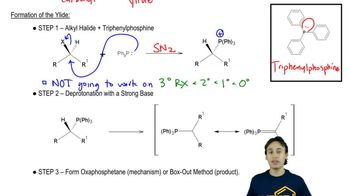
Phosphonium ylides are reactive intermediates formed by the deprotonation of phosphonium salts, characterized by a positively charged phosphorus atom and a negatively charged carbon atom. They are commonly used in the Wittig reaction, which allows for the synthesis of alkenes from carbonyl compounds. The choice of phosphonium ylide is critical, as it determines the structure of the alkene produced in the reaction.
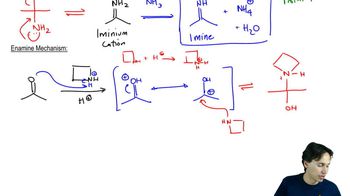
Imine and enamine formation involves the reaction of carbonyl compounds with amines. An imine is formed when a carbonyl compound reacts with a primary amine, while an enamine is produced from a secondary amine. These reactions are significant in organic synthesis, as they provide pathways to create more complex structures and can serve as intermediates in various synthetic routes, including the synthesis of the compounds depicted in the question.