What is the best set of reagents to use for the synthesis?
Verified step by step guidance
1
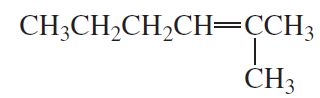
Analyze the target molecule provided in the image. The structure contains an alkene functional group and branching, indicating that the synthesis involves forming a double bond and controlling regioselectivity.
Determine the starting material. Based on the structure, a suitable precursor could be an alkyl halide or alcohol that can undergo elimination to form the alkene.
Choose the elimination reaction type. For this synthesis, a strong base such as NaOH or KOH can be used to promote an E2 elimination reaction, which is ideal for forming alkenes with controlled stereochemistry and regioselectivity.
Consider the reaction conditions. To favor the formation of the more substituted alkene (Zaitsev product), use a strong base and heat. Alternatively, if the less substituted alkene is desired (Hofmann product), use a bulky base like t-BuOK.
Verify the stereochemistry and regioselectivity of the product. Ensure that the chosen reagents and conditions align with the desired alkene structure in the target molecule.
Verified video answer for a similar problem:
This video solution was recommended by our tutors as helpful for the problem above
Video duration:
4m
Play a video:
Was this helpful?
Key Concepts
Here are the essential concepts you must grasp in order to answer the question correctly.
Imine Formation
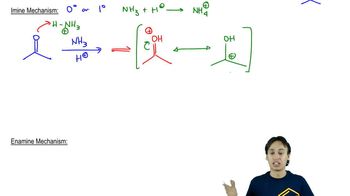
Imine formation is a key reaction in organic chemistry where an aldehyde or ketone reacts with a primary amine to form an imine. This reaction involves the nucleophilic attack of the amine on the carbonyl carbon, followed by dehydration to eliminate water. Understanding this process is crucial for synthesizing compounds that contain imine functional groups.
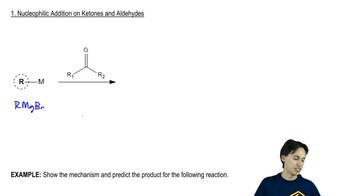
The synthesis of aldehydes and ketones often involves specific reagents such as Grignard reagents, lithium aluminum hydride, or oxidation agents. Each reagent has distinct mechanisms and conditions under which they operate, making it essential to choose the appropriate one based on the desired product and starting materials. Familiarity with these reagents is vital for effective synthesis.
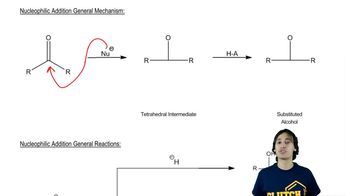
Nucleophilic addition reactions are fundamental in organic chemistry, particularly involving carbonyl compounds like aldehydes and ketones. In these reactions, a nucleophile attacks the electrophilic carbon of the carbonyl group, leading to the formation of alcohols, imines, or other derivatives. Understanding the mechanisms and outcomes of these reactions is essential for predicting the products of synthetic pathways.