Draw structures of the following derivatives. (d) the ethylene acetal of hexan-3-one
Verified step by step guidance
1
Step 1: Understand the problem. The task is to draw the ethylene acetal derivative of hexan-3-one. Hexan-3-one is a ketone with the carbonyl group located on the third carbon of a six-carbon chain. An acetal is formed when a ketone reacts with an alcohol under acidic conditions, and in this case, ethylene glycol (HOCH2CH2OH) is the alcohol used.
Step 2: Identify the reaction mechanism. The formation of an acetal involves two steps: (1) the nucleophilic attack of the alcohol on the carbonyl carbon, and (2) the removal of water to form the acetal structure. Ethylene glycol will react with hexan-3-one to form a cyclic acetal.
Step 3: Draw the structure of hexan-3-one. Represent the six-carbon chain with the ketone group (C=O) on the third carbon. Ensure the remaining carbons are saturated with hydrogen atoms.
Step 4: Draw the ethylene glycol molecule. Ethylene glycol is a two-carbon diol (HOCH2CH2OH). It has hydroxyl groups (-OH) on both ends of the molecule.
Step 5: Combine hexan-3-one and ethylene glycol to form the cyclic acetal. The two hydroxyl groups of ethylene glycol will react with the carbonyl group of hexan-3-one, forming a five-membered ring structure. Replace the carbonyl oxygen with the cyclic acetal structure, ensuring proper connectivity and stereochemistry.
Verified video answer for a similar problem:
This video solution was recommended by our tutors as helpful for the problem above
Video duration:
2m
Play a video:
Was this helpful?
Key Concepts
Here are the essential concepts you must grasp in order to answer the question correctly.
Acetals and Hemiacetals
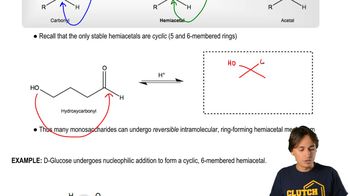
Acetals are formed when an aldehyde or ketone reacts with an alcohol in the presence of an acid catalyst, resulting in a carbon atom bonded to two alkoxy groups and a hydrogen atom. Hemiacetals, on the other hand, contain one alkoxy group and one hydroxyl group. Understanding the formation and structure of acetals is crucial for drawing derivatives like the ethylene acetal.
Hexan-3-one is a ketone with the molecular formula C6H12O, characterized by a carbonyl group (C=O) located at the third carbon of a six-carbon chain. Recognizing the structure of hexan-3-one is essential for understanding how it will react to form its acetal derivative, as the position of the carbonyl group influences the overall structure of the acetal.
The ethylene acetal of a ketone is formed by reacting the ketone with ethylene glycol, which provides two -O- groups. This reaction typically occurs under acidic conditions, leading to the substitution of the carbonyl oxygen with the ethylene glycol moiety. Familiarity with this process is necessary to accurately depict the structure of the ethylene acetal derivative of hexan-3-one.