
Propose a mechanism for the acid-catalyzed reaction of benzaldehyde with methanol to give benzaldehyde dimethyl acetal.
Verified step by step guidance
1
Step 1: Protonation of the carbonyl group in benzaldehyde. The acid catalyst donates a proton (H⁺) to the oxygen atom of the carbonyl group in benzaldehyde, increasing the electrophilicity of the carbonyl carbon. This step can be represented as: → Protonated benzaldehyde.
Step 2: Nucleophilic attack by methanol. Methanol acts as a nucleophile and attacks the electrophilic carbonyl carbon of the protonated benzaldehyde, forming a tetrahedral intermediate. This step involves the formation of a bond between the oxygen atom of methanol and the carbonyl carbon.
Step 3: Deprotonation of the intermediate. The intermediate formed in Step 2 undergoes deprotonation to regenerate the acid catalyst and form a hemiacetal intermediate. This step stabilizes the structure and prepares it for further reaction.
Step 4: Protonation of the hydroxyl group in the hemiacetal. The acid catalyst protonates the hydroxyl group in the hemiacetal intermediate, converting it into a better leaving group. This step increases the reactivity of the intermediate for the next step.
Step 5: Substitution by a second methanol molecule. A second molecule of methanol attacks the electrophilic carbon, displacing the protonated hydroxyl group and forming benzaldehyde dimethyl acetal. The acid catalyst is regenerated in this step, completing the reaction.
Verified video answer for a similar problem:
This video solution was recommended by our tutors as helpful for the problem above
Video duration:
10m
Play a video:
Was this helpful?
Key Concepts
Here are the essential concepts you must grasp in order to answer the question correctly.
Acid-Catalyzed Reactions
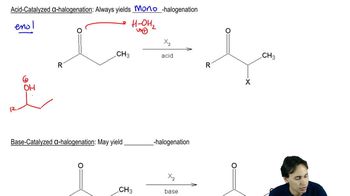
Acid-catalyzed reactions involve the use of an acid to increase the rate of a chemical reaction. In organic chemistry, acids can protonate reactants, making them more electrophilic and facilitating nucleophilic attacks. This is crucial in the formation of acetal from aldehydes, as the acid activates the carbonyl group, allowing for subsequent reactions with alcohols.
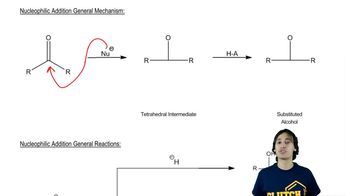
Nucleophilic addition is a fundamental reaction mechanism in organic chemistry where a nucleophile attacks an electrophilic carbon atom, typically in a carbonyl group. In the case of benzaldehyde and methanol, methanol acts as the nucleophile, attacking the carbonyl carbon of benzaldehyde after it has been protonated by the acid, leading to the formation of a hemiacetal intermediate.
The formation of acetals involves the reaction of an aldehyde or ketone with an alcohol in the presence of an acid catalyst. This process typically occurs in two steps: first, the formation of a hemiacetal, followed by the conversion of the hemiacetal into a full acetal through the elimination of water. Understanding this mechanism is essential for proposing the reaction pathway for benzaldehyde dimethyl acetal synthesis.