
Propose a mechanism for the acid-catalyzed reaction of cyclohexanone with ethylene glycol to give cyclohexanone ethylene acetal.
Verified step by step guidance
1
Identify the reaction type: This is an acid-catalyzed acetal formation reaction. Cyclohexanone (a ketone) reacts with ethylene glycol (a diol) in the presence of an acid catalyst to form a cyclic acetal. Acetals are commonly used as protecting groups for carbonyl compounds.
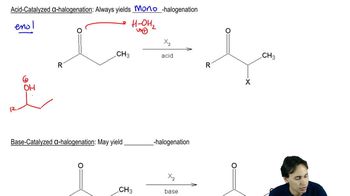
Step 1: Protonation of the carbonyl group. The acid catalyst donates a proton (H⁺) to the oxygen atom of the carbonyl group in cyclohexanone, increasing the electrophilicity of the carbonyl carbon. This makes the carbonyl carbon more susceptible to nucleophilic attack.
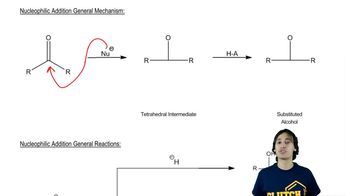
Step 2: Nucleophilic attack by ethylene glycol. One of the hydroxyl groups (-OH) of ethylene glycol acts as a nucleophile and attacks the protonated carbonyl carbon, forming a tetrahedral intermediate. This intermediate contains both a hydroxyl group and an ethylene glycol moiety attached to the former carbonyl carbon.
Step 3: Proton transfer and water elimination. A proton transfer occurs within the intermediate, converting the hydroxyl group into a better leaving group. Subsequently, water (H₂O) is eliminated, forming an oxonium ion intermediate (a positively charged oxygen species).
Step 4: Formation of the cyclic acetal. The second hydroxyl group of ethylene glycol attacks the oxonium ion, forming a new C-O bond and completing the cyclic acetal structure. Finally, the acid catalyst is regenerated by deprotonation of the oxygen atom, ensuring the reaction is catalytic in acid.
Verified video answer for a similar problem:
This video solution was recommended by our tutors as helpful for the problem above
Video duration:
10m
Play a video:
Was this helpful?
Key Concepts
Here are the essential concepts you must grasp in order to answer the question correctly.
Acid-Catalyzed Reactions
Acid-catalyzed reactions involve the use of an acid to increase the rate of a chemical reaction. In organic chemistry, acids can protonate nucleophiles or electrophiles, enhancing their reactivity. This mechanism is crucial in the formation of acetals, where the acid facilitates the reaction between a carbonyl compound and an alcohol by activating the carbonyl carbon.
The formation of acetals occurs when a carbonyl compound, such as a ketone or aldehyde, reacts with an alcohol in the presence of an acid catalyst. This process involves the nucleophilic attack of the alcohol on the carbonyl carbon, followed by the elimination of water and the formation of a stable acetal. Understanding this mechanism is essential for predicting the products of the reaction between cyclohexanone and ethylene glycol.
Nucleophilic attack is a fundamental concept in organic chemistry where a nucleophile, which is an electron-rich species, attacks an electrophile, an electron-deficient species. In the context of the reaction between cyclohexanone and ethylene glycol, the hydroxyl group of ethylene glycol acts as a nucleophile, attacking the electrophilic carbonyl carbon of cyclohexanone, leading to the formation of the acetal.