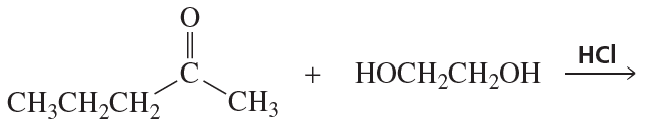
What are the products of the following reactions? f.
Verified step by step guidance
1
Step 1: Identify the reactants. The first reactant is a ketone (2-pentanone), and the second reactant is ethylene glycol (HO-CH2-CH2-OH). The reaction is carried out in the presence of HCl, which acts as an acid catalyst.
Step 2: Recognize the type of reaction. This is an acetal formation reaction, where a ketone reacts with a diol (ethylene glycol) under acidic conditions to form a cyclic acetal.
Step 3: Understand the mechanism. The acid catalyst protonates the carbonyl oxygen of the ketone, increasing the electrophilicity of the carbonyl carbon. Ethylene glycol then attacks the carbonyl carbon, forming a hemiacetal intermediate.
Step 4: The hemiacetal intermediate undergoes further reaction. The hydroxyl group of the hemiacetal is protonated, leading to the loss of water and formation of a carbocation. The second hydroxyl group of ethylene glycol attacks the carbocation, forming a cyclic acetal.
Step 5: The final product is a cyclic acetal, where the ketone is protected by the ethylene glycol. This cyclic acetal is stable under acidic conditions and prevents further reactions at the carbonyl group.
Verified video answer for a similar problem:
This video solution was recommended by our tutors as helpful for the problem above
Video duration:
3m
Play a video:
Was this helpful?
Key Concepts
Here are the essential concepts you must grasp in order to answer the question correctly.
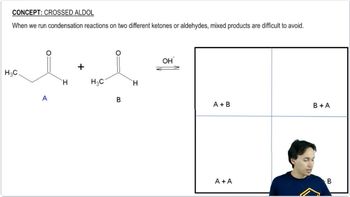
Aldol Condensation
Aldol condensation is a reaction between aldehydes or ketones that contain alpha-hydrogens, leading to the formation of β-hydroxy aldehydes or ketones. This reaction typically occurs in the presence of a base or acid, facilitating the nucleophilic attack of an enolate ion on a carbonyl carbon. The resulting product can further dehydrate to yield an α,β-unsaturated carbonyl compound.
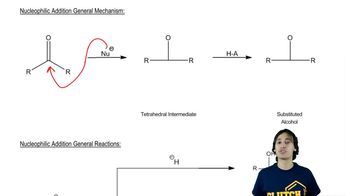
Nucleophilic addition is a fundamental reaction in organic chemistry where a nucleophile attacks an electrophilic carbon atom, typically found in carbonyl compounds like aldehydes and ketones. In this context, the alcohol acts as a nucleophile, adding to the carbonyl carbon of the aldehyde, resulting in the formation of a hemiacetal or acetal, depending on the reaction conditions and the presence of acid catalysts.
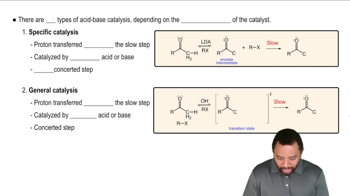
Acid catalysts, such as HCl, are often used to enhance the rate of nucleophilic addition reactions by protonating the carbonyl oxygen, increasing the electrophilicity of the carbonyl carbon. This makes it more susceptible to attack by nucleophiles, such as alcohols. In the context of the given reaction, the presence of HCl facilitates the formation of the final product by promoting the addition of the alcohol to the aldehyde.