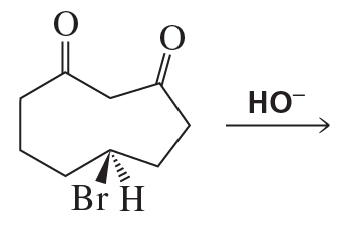
Analyze the structure of the reactant: The molecule contains two ketone groups and a chlorine atom attached to a stereogenic center. The reaction involves hydroxide ion (HO⁻), which is a strong nucleophile and base.
Identify the reactive sites: The chlorine atom is a good leaving group, and the hydroxide ion can act as a nucleophile to replace the chlorine via an SN2 mechanism. Additionally, the hydroxide ion can deprotonate acidic hydrogens if present.
Predict the mechanism: The hydroxide ion will attack the carbon bonded to the chlorine atom, displacing the chlorine in an SN2 reaction. This will invert the stereochemistry at the carbon center due to the backside attack characteristic of SN2 reactions.
Consider the stability of the product: The resulting molecule will have a hydroxyl group (-OH) replacing the chlorine atom. The stereochemistry of the hydroxyl group will be inverted compared to the original chlorine atom.
Draw the product: Replace the chlorine atom with a hydroxyl group (-OH) at the stereogenic center, ensuring the stereochemistry is inverted. The rest of the molecule, including the ketone groups, remains unchanged.
Verified video answer for a similar problem:
This video solution was recommended by our tutors as helpful for the problem above
Video duration:
1m
Play a video:
Was this helpful?
Key Concepts
Here are the essential concepts you must grasp in order to answer the question correctly.
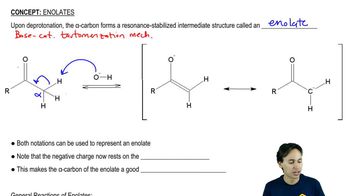
Enolate Formation
Enolates are formed from carbonyl compounds (like ketones or aldehydes) through deprotonation at the alpha carbon. This process generates a resonance-stabilized anion that can act as a nucleophile in subsequent reactions. Understanding enolate formation is crucial for predicting the products of reactions involving carbonyl compounds.
Alkylation of enolates involves the nucleophilic attack of the enolate on an alkyl halide, leading to the formation of a new carbon-carbon bond. This reaction is significant in organic synthesis as it allows for the introduction of alkyl groups to carbonyl compounds, expanding the complexity of the molecule. The choice of alkyl halide can influence the regioselectivity and stereochemistry of the product.
Carbonyl compounds, such as aldehydes and ketones, exhibit unique reactivity due to the polarized carbon-oxygen double bond. This polarization makes the carbon atom electrophilic, allowing it to participate in various nucleophilic addition reactions. Understanding the reactivity of carbonyls is essential for predicting the outcomes of reactions involving these functional groups, including their interactions with enolates.