Show how 4-methyl-3-hexanol can be synthesized from 3-pentanone.
Verified step by step guidance
1
Step 1: Begin with the starting material, 3-pentanone. Recognize that the target molecule, 4-methyl-3-hexanol, is an alcohol with a methyl group added to the carbon adjacent to the ketone group in 3-pentanone. This suggests a Grignard reaction as a key step.
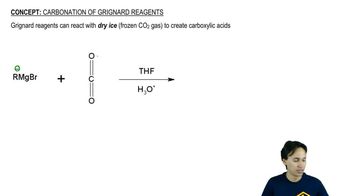
Step 2: Prepare the Grignard reagent. React methyl bromide (CH₃Br) with magnesium (Mg) in an ether solvent to form the Grignard reagent, CH₃MgBr. This reagent will act as a nucleophile in the next step.
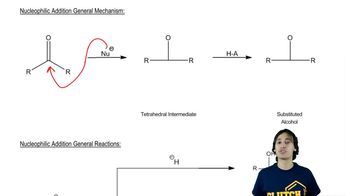
Step 3: Perform the nucleophilic addition reaction. Add the Grignard reagent (CH₃MgBr) to 3-pentanone. The carbonyl group (C=O) in 3-pentanone will undergo nucleophilic attack by the methyl group from the Grignard reagent, forming a tertiary alkoxide intermediate.
Step 4: Protonate the alkoxide intermediate. Treat the reaction mixture with a dilute acid, such as H₃O⁺, to protonate the alkoxide and form the desired alcohol, 4-methyl-3-hexanol.
Step 5: Verify the structure of the product. Confirm that the product has the correct connectivity and stereochemistry (if applicable) to ensure it matches the target molecule, 4-methyl-3-hexanol.
Verified video answer for a similar problem:
This video solution was recommended by our tutors as helpful for the problem above
Video duration:
3m
Play a video:
Was this helpful?
Key Concepts
Here are the essential concepts you must grasp in order to answer the question correctly.
Nucleophilic Addition
Nucleophilic addition is a fundamental reaction in organic chemistry where a nucleophile attacks an electrophilic carbon atom, typically in a carbonyl group. In the synthesis of 4-methyl-3-hexanol from 3-pentanone, this reaction is crucial as it allows the introduction of new carbon chains through the addition of nucleophiles, leading to the formation of alcohols.
Grignard reagents are organomagnesium compounds that act as strong nucleophiles in organic synthesis. They can react with carbonyl compounds like ketones to form alcohols. In this synthesis, a Grignard reagent derived from an appropriate alkyl halide can be used to add a methyl group to 3-pentanone, ultimately yielding 4-methyl-3-hexanol.
Reduction reactions involve the gain of electrons or hydrogen, or the loss of oxygen, resulting in the conversion of carbonyl compounds to alcohols. In the context of synthesizing 4-methyl-3-hexanol, the reduction of the intermediate formed after nucleophilic addition is essential to convert the ketone functional group into the desired alcohol, completing the synthesis.