Textbook Question
Many of the condensations we have studied are reversible. The reverse reactions are often given the prefix retro-, the Latin word meaning “backward.” Propose mechanisms to account for the following reactions.
(b)
637
views

 Wade 9th EditionCh. 22 - Condensations and Alpha Substitutions of Carbonyl CompoundsProblem 79a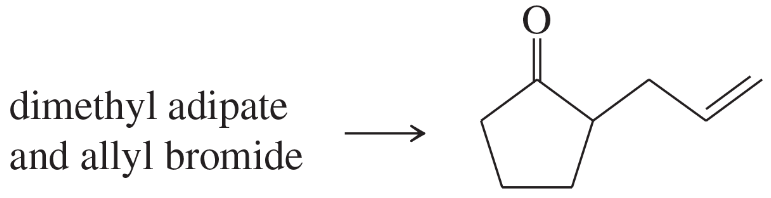
 Verified step by step guidance
 02:16
02:16
 02:36
02:36 01:52
01:52Many of the condensations we have studied are reversible. The reverse reactions are often given the prefix retro-, the Latin word meaning “backward.” Propose mechanisms to account for the following reactions.
(b)
Many of the condensations we have studied are reversible. The reverse reactions are often given the prefix retro-, the Latin word meaning “backward.” Propose mechanisms to account for the following reactions.
(c)
Write equations showing the expected products of the following enamine alkylation and acylation reactions. Then give the final products expected after hydrolysis of the iminium salts.
(d) piperidine enamine of cyclopentanone + methyl vinyl ketone
Write equations showing the expected products of the following enamine alkylation and acylation reactions. Then give the final products expected after hydrolysis of the iminium salts.
(c) piperidine enamine of cyclopentanone + methyl iodide
Write equations showing the expected products of the following enamine alkylation and acylation reactions. Then give the final products expected after hydrolysis of the iminium salts.
(a) pyrrolidine enamine of pentan-3-one + allyl chloride
(b) pyrrolidine enamine of acetophenone + butanoyl chloride
Many of the condensations we have studied are reversible. The reverse reactions are often given the prefix retro-, the Latin word meaning “backward.” Propose mechanisms to account for the following reactions.
(a)