a. What is each compound’s systematic name? b. Draw a skeletal structure for each condensed structure given and draw a condensed structure for each skeletal structure. 3. 4. (CH3CH2)4C
Verified step by step guidance
1
Step 1: Analyze the given condensed structure in the image. The compound contains a chain of carbon atoms with substituents. Identify the longest continuous chain of carbon atoms to determine the parent name of the compound.
Step 2: Number the carbon atoms in the longest chain starting from the end closest to the substituent groups (methyl and hydroxyl groups) to ensure the lowest possible numbers for the substituents.
Step 3: Identify and name the substituents attached to the main chain. In this case, there is a methyl group (-CH3) and a hydroxyl group (-OH). Assign their positions based on the numbering of the main chain.
Step 4: Combine the substituent names with the parent chain name, ensuring proper placement of locants (numbers indicating positions) and using the correct suffix for the functional group (e.g., '-ol' for alcohols).
Step 5: Draw the skeletal structure for the compound by representing the carbon chain as a zigzag line and showing the substituents at their respective positions. Then, convert the skeletal structure back into a condensed structure by explicitly writing out all bonds and atoms.
Verified video answer for a similar problem:
This video solution was recommended by our tutors as helpful for the problem above
Video duration:
3m
Play a video:
Was this helpful?
Key Concepts
Here are the essential concepts you must grasp in order to answer the question correctly.
Systematic Naming of Organic Compounds
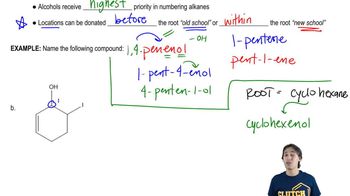
Systematic naming, or IUPAC nomenclature, is a standardized method for naming organic compounds based on their structure. It involves identifying the longest carbon chain, naming substituents, and assigning locants to indicate the position of functional groups. For example, in the provided structure, the presence of an alcohol group (-OH) influences the naming, leading to the identification of the compound as an alcohol.
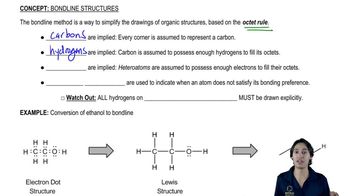
Skeletal structures are simplified representations of organic molecules that depict the carbon backbone and functional groups without showing all hydrogen atoms. Each vertex represents a carbon atom, and hydrogen atoms are implied. This method allows for a clearer visualization of complex molecules, making it easier to identify functional groups and connectivity, which is essential for drawing and interpreting organic compounds.
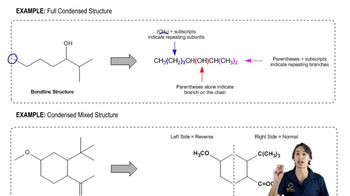
Condensed structures provide a way to represent organic compounds in a more compact form than skeletal structures. They show the arrangement of atoms and groups in a linear format, indicating how atoms are bonded. For instance, the condensed structure (CH3CH2)4C indicates a branched alkane with four ethyl groups attached to a central carbon, which is crucial for understanding the compound's structure and reactivity.