Give each of the following a systematic name and indicate whether each is a primary, secondary, or tertiary alcohol: a. b.
Verified step by step guidance
1
Step 1: Analyze the first structure (CH3CH2CH2CH2CH2CH2OH). Identify the longest continuous carbon chain, which contains six carbons. The hydroxyl (-OH) group is attached to the terminal carbon, making it a primary alcohol.
Step 2: Assign the systematic name for the first structure. The parent chain is hexane, and the hydroxyl group is on the first carbon. The name is 1-hexanol.
Step 3: Analyze the second structure. Identify the longest continuous carbon chain, which contains five carbons. The hydroxyl (-OH) group is attached to the second carbon, and there is a methyl group also attached to the second carbon. Additionally, there is a chlorine atom attached to the fifth carbon.
Step 4: Assign the systematic name for the second structure. The parent chain is pentane, and substituents are named in alphabetical order. The hydroxyl group is on the second carbon, the methyl group is on the second carbon, and the chlorine atom is on the fifth carbon. The name is 2-methyl-5-chloropentan-2-ol.
Step 5: Determine the type of alcohol for the second structure. Since the hydroxyl group is attached to a carbon that is bonded to two other carbons, it is a secondary alcohol.
Verified video answer for a similar problem:
This video solution was recommended by our tutors as helpful for the problem above
Video duration:
2m
Play a video:
Was this helpful?
Key Concepts
Here are the essential concepts you must grasp in order to answer the question correctly.
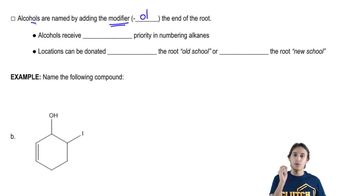
Systematic Naming of Alcohols
Systematic naming of alcohols follows the IUPAC nomenclature rules, where the longest carbon chain containing the hydroxyl (-OH) group is identified. The suffix '-ol' is added to the name of the alkane corresponding to the longest chain, and the position of the -OH group is indicated by a number. For example, in butanol, the -OH group is on the first carbon of a four-carbon chain.
Alcohols are classified based on the number of carbon atoms bonded to the carbon atom that carries the hydroxyl group. A primary alcohol has the -OH group attached to a carbon that is bonded to only one other carbon, a secondary alcohol has it attached to a carbon bonded to two other carbons, and a tertiary alcohol has it attached to a carbon bonded to three other carbons. This classification affects the alcohol's reactivity and properties.
Understanding structural representations, such as condensed formulas or skeletal structures, is crucial for identifying functional groups and determining the classification of alcohols. These representations visually convey how atoms are connected in a molecule, allowing for the identification of the longest carbon chain and the position of the hydroxyl group, which are essential for systematic naming and classification.