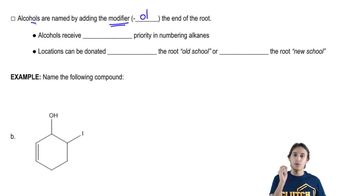
Give each of the following a systematic name and indicate whether each is a primary, secondary, or tertiary alcohol: a. b.
Verified step by step guidance
1
Step 1: Identify the longest carbon chain that contains the hydroxyl group (-OH) in each molecule. This chain will determine the base name of the alcohol.
Step 2: Number the carbon atoms in the chain starting from the end nearest to the hydroxyl group. This ensures the -OH group gets the lowest possible number.
Step 3: Identify and name any substituents attached to the carbon chain. Use the appropriate prefixes (e.g., methyl, ethyl) and indicate their position on the chain using the numbering from Step 2.
Step 4: Combine the names from Steps 1 and 3 to form the complete IUPAC name of the alcohol. The position of the hydroxyl group should be indicated by a number before the suffix '-ol'.
Step 5: Determine the classification of the alcohol as primary, secondary, or tertiary. A primary alcohol has the -OH group attached to a carbon with two hydrogens, a secondary alcohol has it attached to a carbon with one hydrogen, and a tertiary alcohol has it attached to a carbon with no hydrogens.
Verified video answer for a similar problem:
This video solution was recommended by our tutors as helpful for the problem above
Video duration:
2m
Play a video:
0 Comments
Key Concepts
Here are the essential concepts you must grasp in order to answer the question correctly.
Systematic Naming of Alcohols
Systematic naming of alcohols follows the IUPAC nomenclature rules, where the longest carbon chain containing the hydroxyl (-OH) group is identified. The suffix '-ol' is added to the name of the alkane corresponding to the number of carbon atoms, and the position of the -OH group is indicated by a number. For example, in butanol, the 'but-' indicates four carbons, and the '-ol' signifies the presence of an alcohol.
Alcohols are classified based on the number of carbon atoms bonded to the carbon atom that carries the hydroxyl group. A primary alcohol has the -OH group attached to a carbon that is connected to only one other carbon, a secondary alcohol has it attached to a carbon connected to two other carbons, and a tertiary alcohol has it attached to a carbon connected to three other carbons. This classification affects the alcohol's reactivity and properties.
Understanding structural representations, such as condensed formulas or skeletal structures, is crucial for identifying functional groups and the overall structure of organic compounds. These representations help in visualizing the arrangement of atoms and bonds, which is essential for determining the systematic name and classification of alcohols. Familiarity with these structures allows for accurate interpretation of the compounds in the question.


 2:04 minutes

 Verified step by step guidance
 01:01
01:01