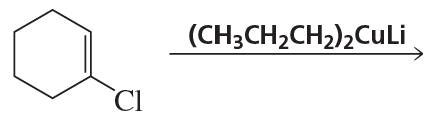
What are the products of the following reactions? e.
Verified step by step guidance
1
Identify the type of reaction taking place. For example, determine if it is a substitution, elimination, addition, or rearrangement reaction. This will depend on the reactants and reaction conditions provided.
Analyze the structure of the reactants. Look for functional groups, stereochemistry, and any reactive sites (e.g., double bonds, lone pairs, or leaving groups).
Consider the reaction conditions (e.g., reagents, solvents, temperature). These often provide clues about the mechanism. For instance, the presence of a strong base might suggest an elimination reaction, while an acid catalyst might indicate an addition reaction.
Write out the mechanism step by step. Show how bonds are broken and formed, and ensure that all intermediates (e.g., carbocations, radicals) are accounted for. Use curved arrows to indicate electron movement.
Determine the final products by completing the reaction mechanism. Ensure that the products are stable and consistent with the reaction type and conditions. If stereochemistry is relevant, indicate the configuration of the products (e.g., E/Z or R/S).
Verified video answer for a similar problem:
This video solution was recommended by our tutors as helpful for the problem above
Video duration:
3m
Play a video:
Was this helpful?
Key Concepts
Here are the essential concepts you must grasp in order to answer the question correctly.
Reaction Mechanisms
Understanding reaction mechanisms is crucial in organic chemistry as they describe the step-by-step process by which reactants transform into products. This includes identifying intermediates, transition states, and the movement of electrons. Familiarity with mechanisms helps predict the products of reactions based on the types of reactants and conditions involved.
Functional groups are specific groups of atoms within molecules that are responsible for the characteristic chemical reactions of those molecules. Recognizing functional groups is essential for predicting the behavior of organic compounds during reactions, as different groups can lead to different products based on their reactivity and the conditions of the reaction.
Stoichiometry involves the calculation of reactants and products in chemical reactions. It is essential for determining the amounts of substances consumed and produced in a reaction, allowing chemists to predict yields and understand the relationships between different compounds. Mastery of stoichiometry is vital for accurately answering questions about reaction products.