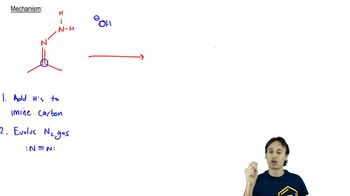
Propose a mechanism for both parts of the Wolff–Kishner reduction of cyclohexanone: the formation of the hydrazone, and then the base-catalyzed reduction with evolution of nitrogen gas.
Verified step by step guidance
1
Step 1: Formation of the hydrazone - Start with cyclohexanone (a ketone) and hydrazine (NH₂NH₂). The carbonyl group (C=O) of cyclohexanone reacts with hydrazine in the presence of an acid catalyst. This involves nucleophilic attack by the lone pair on the nitrogen of hydrazine on the electrophilic carbon of the carbonyl group, forming a tetrahedral intermediate.
Step 2: Proton transfer - In the tetrahedral intermediate, a proton transfer occurs, leading to the elimination of water (H₂O) and the formation of a double bond between the carbon and nitrogen. This results in the formation of the hydrazone (C=N-NH₂).
Step 3: Base-catalyzed reduction - In the second part of the mechanism, the hydrazone is treated with a strong base, such as KOH, and heat. The base deprotonates the terminal nitrogen (NH₂ group), forming a resonance-stabilized anion.
Step 4: Nitrogen gas evolution - The resonance-stabilized anion undergoes further deprotonation and rearrangement, leading to the cleavage of the N-N bond and the release of nitrogen gas (N₂). This step is driven by the stability of nitrogen gas as a product.
Step 5: Formation of the alkane - The remaining carbon fragment is protonated by water or another proton source, resulting in the formation of cyclohexane, the fully reduced product.
Verified video answer for a similar problem:
This video solution was recommended by our tutors as helpful for the problem above
Video duration:
6m
Play a video:
Was this helpful?
Key Concepts
Here are the essential concepts you must grasp in order to answer the question correctly.
Wolff–Kishner Reduction
The Wolff–Kishner reduction is a chemical reaction used to convert carbonyl compounds, such as ketones and aldehydes, into alkanes. This process involves the formation of a hydrazone intermediate, which is then treated with a strong base, typically hydrazine and potassium hydroxide, to facilitate the removal of nitrogen gas and reduce the carbonyl compound.
The formation of a hydrazone occurs when a carbonyl compound reacts with hydrazine. This reaction involves the nucleophilic attack of the hydrazine on the carbonyl carbon, leading to the formation of a C=N bond. The resulting hydrazone is a key intermediate in the Wolff–Kishner reduction, which stabilizes the carbonyl compound for subsequent reduction.
In the base-catalyzed reduction step of the Wolff–Kishner reaction, the hydrazone undergoes deprotonation by a strong base, generating a reactive intermediate. This intermediate then eliminates nitrogen gas, resulting in the formation of an alkane. The evolution of nitrogen gas is a driving force for the reaction, facilitating the conversion of the hydrazone to the final hydrocarbon product.