Propose a mechanism for both parts of the Wolff–Kishner reduction of cyclohexanone: the formation of the hydrazone, and then the base-catalyzed reduction with evolution of nitrogen gas.
Verified step by step guidance
1
Step 1: Begin by understanding the Wolff–Kishner reduction mechanism. It involves two main stages: (1) formation of the hydrazone and (2) base-catalyzed reduction with nitrogen gas evolution. Cyclohexanone serves as the starting ketone.
Step 2: Formation of the hydrazone: Cyclohexanone reacts with hydrazine (NH₂NH₂) under acidic or neutral conditions. The carbonyl group (C=O) of cyclohexanone undergoes nucleophilic attack by the lone pair on the nitrogen atom of hydrazine. This forms a tetrahedral intermediate, which then eliminates water to yield the hydrazone (C=N-NH₂).
Step 3: Base-catalyzed reduction: In the presence of a strong base (e.g., KOH), the hydrazone undergoes deprotonation at the terminal nitrogen (NH₂ group), forming a resonance-stabilized anion. This sets the stage for the next step.
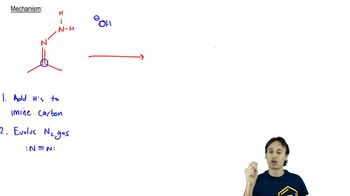
Step 4: Nitrogen gas evolution: The resonance-stabilized anion undergoes further deprotonation and rearrangement, leading to cleavage of the N-N bond. This results in the formation of nitrogen gas (N₂) and a carbanion intermediate.
Step 5: Final reduction: The carbanion intermediate abstracts a proton from the solvent or base, yielding the fully reduced hydrocarbon (cyclohexane in this case). The reaction is complete, and nitrogen gas is released as a byproduct.
Verified video answer for a similar problem:
This video solution was recommended by our tutors as helpful for the problem above
Video duration:
6m
Play a video:
0 Comments
Key Concepts
Here are the essential concepts you must grasp in order to answer the question correctly.
Wolff–Kishner Reduction
The Wolff–Kishner reduction is a chemical reaction used to convert carbonyl compounds, such as ketones and aldehydes, into alkanes. This process involves the formation of a hydrazone intermediate, which is then treated with a strong base, typically hydrazine and potassium hydroxide, to facilitate the removal of nitrogen gas and reduce the carbonyl compound.
The formation of a hydrazone occurs when a carbonyl compound reacts with hydrazine. This reaction involves the nucleophilic attack of the hydrazine on the carbonyl carbon, leading to the formation of a C=N bond. The resulting hydrazone is a key intermediate in the Wolff–Kishner reduction, which stabilizes the carbonyl compound for subsequent reduction.
In the base-catalyzed reduction step of the Wolff–Kishner reaction, the hydrazone undergoes deprotonation by a strong base, leading to the formation of a carbanion. This carbanion then eliminates nitrogen gas, resulting in the formation of the corresponding alkane. The evolution of nitrogen gas is a driving force for the reaction, facilitating the complete reduction of the carbonyl compound.


 6:49 minutes
 Verified step by step guidance
 04:57
04:57