Show the product expected by the Wolff–Kishner reduction of the following aldehydes/ketones. (a)
Verified step by step guidance
1
Identify the functional group in the given compound that will undergo the Wolff–Kishner reduction. In this case, it is the carbonyl group (C=O) of the ketone.
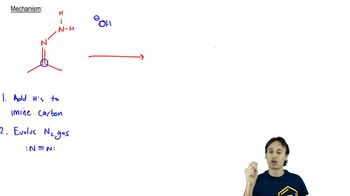
Understand that the Wolff–Kishner reduction is a method used to convert carbonyl groups into methylene groups (CH2) using hydrazine (H2NNH2) and a strong base like KOH under high temperature.
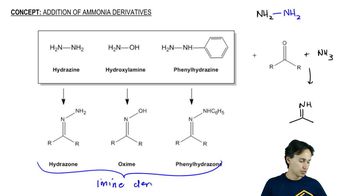
Recognize that the reaction involves the formation of a hydrazone intermediate, where the carbonyl oxygen is replaced by a hydrazine moiety, followed by the elimination of nitrogen gas (N2) to form the alkane.
Apply the Wolff–Kishner reduction to the given ketone. Replace the carbonyl group with a methylene group, effectively removing the oxygen and adding two hydrogen atoms to the carbonyl carbon.
Draw the final product structure, ensuring that the pyridine ring and the ethyl group remain unchanged, while the carbonyl carbon is now part of a methylene group, resulting in a fully saturated carbon chain.
Verified video answer for a similar problem:
This video solution was recommended by our tutors as helpful for the problem above
Video duration:
1m
Play a video:
Was this helpful?
Key Concepts
Here are the essential concepts you must grasp in order to answer the question correctly.
Wolff–Kishner Reduction
The Wolff–Kishner reduction is a chemical reaction used to convert carbonyl compounds, such as aldehydes and ketones, into alkanes. This process involves the hydrazone formation followed by the treatment with a strong base, typically potassium hydroxide, and heating, which leads to the removal of nitrogen gas and the formation of the corresponding alkane.
Carbonyl compounds are organic molecules that contain a carbon atom double-bonded to an oxygen atom (C=O). This functional group is characteristic of aldehydes and ketones, which differ in their structure; aldehydes have at least one hydrogen atom attached to the carbonyl carbon, while ketones have two carbon groups attached. Understanding their structure is crucial for predicting the outcome of reactions like the Wolff–Kishner reduction.
Hydrazones are compounds formed by the reaction of hydrazine with carbonyl compounds, resulting in a C=N bond. In the context of the Wolff–Kishner reduction, the formation of a hydrazone intermediate is essential, as it stabilizes the carbonyl compound and facilitates the subsequent elimination of nitrogen gas, ultimately leading to the formation of the alkane product.