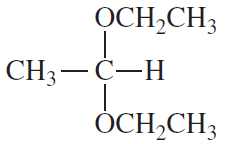
Which of the following are a. hemiacetals? b. acetals? c. hydrates? 2.
Verified step by step guidance
1
Step 1: Understand the definitions of the terms provided in the question. A hemiacetal contains one -OR group and one -OH group attached to the same carbon atom. An acetal contains two -OR groups attached to the same carbon atom. A hydrate contains two -OH groups attached to the same carbon atom.
Step 2: Analyze the given structure in the image. The central carbon atom is bonded to two -OR groups (methoxy groups, -OCH3) and two alkyl groups. There is no -OH group present in the structure.
Step 3: Compare the structure to the definitions. Since the central carbon atom has two -OR groups and no -OH group, this structure fits the definition of an acetal.
Step 4: Confirm that the structure does not fit the definitions of a hemiacetal or a hydrate. A hemiacetal would require one -OR group and one -OH group, and a hydrate would require two -OH groups, neither of which are present in this structure.
Step 5: Conclude that the given structure is an acetal and does not qualify as a hemiacetal or a hydrate.
Verified video answer for a similar problem:
This video solution was recommended by our tutors as helpful for the problem above
Video duration:
3m
Play a video:
Was this helpful?
Key Concepts
Here are the essential concepts you must grasp in order to answer the question correctly.
Hemiacetals
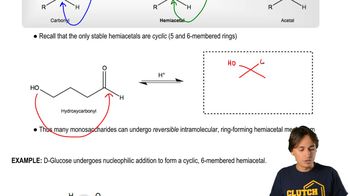
Hemiacetals are formed when an aldehyde or ketone reacts with an alcohol, resulting in a compound that contains both an alcohol and an ether functional group. They typically have one -OH group and one -O-alkyl group attached to the same carbon atom. Hemiacetals are often intermediates in the formation of acetals and can be identified by their structure, which includes a carbon atom bonded to both an alcohol and an alkoxy group.
Acetals are derived from hemiacetals through a reaction with an additional alcohol, leading to a compound that has two -O-alkyl groups attached to the same carbon atom. They are stable under neutral conditions and are characterized by their resistance to hydrolysis compared to hemiacetals. Acetals play a significant role in organic synthesis and can be used to protect carbonyl groups during chemical reactions.
Hydrates are formed when water adds to a carbonyl compound, such as an aldehyde or ketone, resulting in a molecule that contains a hydroxyl group (-OH) and a carbon atom. This process is known as hydration and leads to the formation of a geminal diol, where two hydroxyl groups are attached to the same carbon. Hydrates are often less stable than their carbonyl precursors and can revert back to the original carbonyl compound under certain conditions.