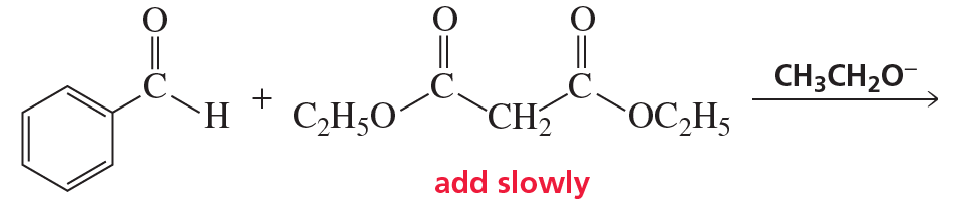
There are other condensation reactions similar to the aldol and Claisen condensations: c. The Knoevenagel condensation is the condensation of an aldehyde or a ketone that has no a-hydrogens and a compound such as diethyl malonate that has an a-carbon flanked by two electron-withdrawing groups. Draw the product obtained from the following Knoevenagel condensation:
Verified step by step guidance
1
Step 1: Identify the reactants in the Knoevenagel condensation. The first reactant is an aldehyde or ketone without α-hydrogens, which in this case is the aromatic ketone (4-methylbenzophenone). The second reactant is diethyl malonate, which has an α-carbon flanked by two electron-withdrawing groups (the ester groups). The base used is sodium ethoxide (EtONa).
Step 2: Deprotonation of the α-carbon in diethyl malonate occurs due to the presence of the strong base (EtONa). This generates a resonance-stabilized enolate ion. The enolate ion is nucleophilic and will attack the electrophilic carbonyl carbon of the ketone.
Step 3: The nucleophilic enolate ion attacks the carbonyl carbon of the ketone, forming a new carbon-carbon bond. This step results in the formation of a β-hydroxy intermediate.
Step 4: Under the reaction conditions, the β-hydroxy intermediate undergoes dehydration (loss of water) to form a conjugated double bond. This elimination step leads to the formation of an α,β-unsaturated product.
Step 5: The final product is a conjugated system where the diethyl malonate has condensed with the ketone, forming a compound with a double bond between the α-carbon of diethyl malonate and the carbonyl carbon of the ketone. The electron-withdrawing ester groups stabilize the conjugated system.
Verified video answer for a similar problem:
This video solution was recommended by our tutors as helpful for the problem above
Video duration:
3m
Play a video:
Was this helpful?
Key Concepts
Here are the essential concepts you must grasp in order to answer the question correctly.
Knoevenagel Condensation
The Knoevenagel condensation is a reaction between an aldehyde or a ketone lacking alpha-hydrogens and a compound with an active methylene group, typically flanked by electron-withdrawing groups. This reaction results in the formation of a β-unsaturated carbonyl compound through the elimination of water. It is a key method for synthesizing enones and enals, which are important intermediates in organic synthesis.
An active methylene group refers to a methylene (-CH2-) group that is adjacent to two electron-withdrawing groups, making it highly acidic and reactive. This acidity allows for the deprotonation of the methylene hydrogen, facilitating nucleophilic attack on electrophiles, such as carbonyl compounds in condensation reactions. In the context of the Knoevenagel condensation, this group is essential for forming the new carbon-carbon bond.
Electron-withdrawing groups (EWGs) are substituents that pull electron density away from the rest of the molecule, stabilizing negative charges and increasing the electrophilicity of nearby carbonyl groups. Common examples include nitro (-NO2), cyano (-CN), and carbonyl (-C=O) groups. In the Knoevenagel condensation, the presence of EWGs enhances the reactivity of the active methylene compound, making it more likely to participate in the reaction.