Propose a mechanism for the self-condensation of methyl 3-phenylpropionate promoted by sodium methoxide.
Verified step by step guidance
1
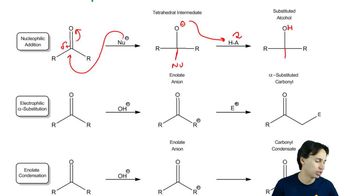
Identify the reaction type: The self-condensation of methyl 3-phenylpropionate is a Claisen condensation, which involves the reaction of two ester molecules in the presence of a strong base to form a β-keto ester.
Step 1: Deprotonation of the α-hydrogen. Sodium methoxide (a strong base) abstracts the acidic α-hydrogen from one molecule of methyl 3-phenylpropionate, forming a resonance-stabilized enolate ion. Represent the enolate ion as: CH2(C6H5)COOCH3 → CH(C6H5)=C-OCH3.
Step 2: Nucleophilic attack by the enolate. The enolate ion acts as a nucleophile and attacks the carbonyl carbon of a second molecule of methyl 3-phenylpropionate. This forms a tetrahedral intermediate. Represent the intermediate as: CH(C6H5)=C-OCH3 + CH2(C6H5)COOCH3 → [tetrahedral intermediate].
Step 3: Elimination of methoxide ion. The tetrahedral intermediate collapses, expelling a methoxide ion (CH3O-) and forming the β-keto ester product. Represent the product as: CH(C6H5)COCH(C6H5)COOCH3.
Step 4: Regeneration of the base. The expelled methoxide ion can deprotonate another molecule of methyl 3-phenylpropionate, continuing the catalytic cycle. This ensures that sodium methoxide is regenerated and can promote further reactions.
Verified video answer for a similar problem:
This video solution was recommended by our tutors as helpful for the problem above
Play a video:
Was this helpful?
Key Concepts
Here are the essential concepts you must grasp in order to answer the question correctly.
Self-Condensation
Self-condensation is a reaction where a molecule reacts with itself to form a larger compound. In the case of methyl 3-phenylpropionate, this process involves the formation of a new carbon-carbon bond between two identical molecules, leading to the creation of a dimer or oligomer. Understanding this concept is crucial for predicting the products and mechanisms involved in the reaction.
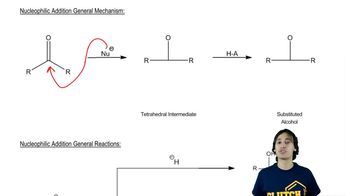
Nucleophilic attack is a fundamental reaction mechanism in organic chemistry where a nucleophile, which is an electron-rich species, attacks an electrophile, an electron-deficient species. In this scenario, sodium methoxide acts as a nucleophile, attacking the carbonyl carbon of methyl 3-phenylpropionate, facilitating the formation of a new bond. This step is essential for understanding how the self-condensation occurs.
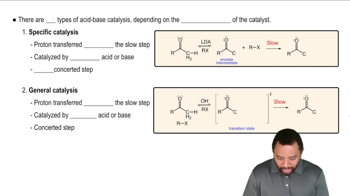
Base catalysis refers to the acceleration of a chemical reaction by a base, which can deprotonate acidic protons and generate nucleophiles. In this reaction, sodium methoxide not only serves as a nucleophile but also acts as a base, enhancing the reactivity of the carbonyl compound. Recognizing the role of base catalysis is vital for comprehending the overall mechanism of the self-condensation process.