Predict the products of the following reactions. (c) 1-methylcyclohexanol + H2SO4, heat (d) product of (c) + H2, Pt
Verified step by step guidance
1
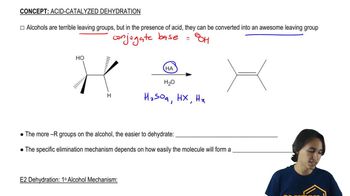
Step 1: Analyze the reaction in part (c). The reaction involves 1-methylcyclohexanol with H₂SO₄ (sulfuric acid) and heat. This is a dehydration reaction, where the alcohol group (-OH) is eliminated to form an alkene. The mechanism proceeds via protonation of the -OH group, followed by the formation of a carbocation intermediate, and finally elimination of a proton to form the double bond.
Step 2: Consider the stability of the carbocation intermediate in part (c). The carbocation formed after the loss of water will be a secondary carbocation. However, a hydride shift can occur to form a more stable tertiary carbocation at the 1-methyl position. This rearrangement leads to the formation of the most stable alkene as the major product.
Step 3: Predict the product of part (c). After the carbocation rearrangement, the elimination step will result in the formation of the most substituted and stable alkene (Zaitsev's rule). The product will be a methyl-substituted cyclohexene.
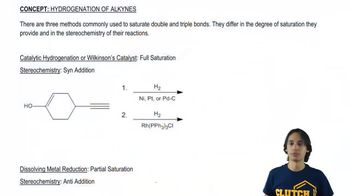
Step 4: Analyze the reaction in part (d). The product of part (c) (an alkene) reacts with H₂ in the presence of Pt (platinum catalyst). This is a catalytic hydrogenation reaction, where the double bond in the alkene is reduced to a single bond, forming an alkane.
Step 5: Predict the product of part (d). The hydrogenation reaction will add one hydrogen atom to each carbon of the double bond, converting the alkene into a saturated alkane. The final product will be a methyl-substituted cyclohexane.
Verified video answer for a similar problem:
This video solution was recommended by our tutors as helpful for the problem above
Video duration:
6m
Play a video:
Was this helpful?
Key Concepts
Here are the essential concepts you must grasp in order to answer the question correctly.
Acid-Catalyzed Dehydration
In the presence of a strong acid like H2SO4, alcohols can undergo dehydration to form alkenes. This process involves the protonation of the alcohol, leading to the formation of a carbocation intermediate, which can then lose a water molecule. The stability of the carbocation and the possibility of rearrangements are crucial factors in determining the major product.
Hydrogenation is a chemical reaction that involves the addition of hydrogen (H2) to an unsaturated compound, typically in the presence of a catalyst such as platinum (Pt). This process converts alkenes or alkynes into alkanes, effectively saturating the molecule. Understanding the conditions and catalysts used in hydrogenation is essential for predicting the final product of the reaction.
Regioselectivity refers to the preference of a chemical reaction to yield one structural isomer over others when multiple possibilities exist. In the context of dehydration and hydrogenation, the formation of specific products can depend on the stability of intermediates and the orientation of reactants. Stereochemistry also plays a role, as the spatial arrangement of atoms can affect the properties and reactivity of the resulting compounds.