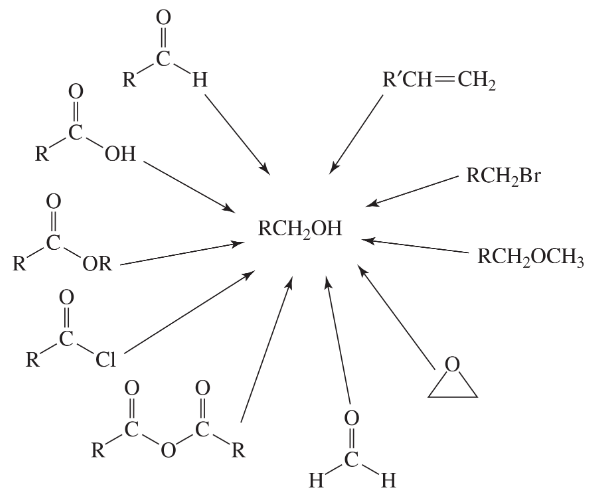
a. Show the reagents required to form the primary alcohol in each of the following reactions.
Verified step by step guidance
1
Step 1: Analyze the starting material, which is an ester with two carbonyl groups. The reaction involves breaking the ester bond to form a carboxylic acid and a primary alcohol.
Step 2: Recognize that the reaction requires hydrolysis of the ester. This can be achieved using either acidic or basic conditions. Common reagents include water (H₂O) with an acid catalyst like HCl for acidic hydrolysis, or a strong base like NaOH for basic hydrolysis.
Step 3: In acidic hydrolysis, the ester is protonated by the acid catalyst, making the carbonyl carbon more electrophilic. Water then attacks the carbonyl carbon, leading to the formation of the carboxylic acid and alcohol.
Step 4: In basic hydrolysis (saponification), the hydroxide ion directly attacks the carbonyl carbon of the ester, forming a carboxylate ion and the alcohol. The carboxylate ion can be protonated later to form the carboxylic acid.
Step 5: Based on the reaction shown, the reagents required to form the primary alcohol are water (H₂O) and either an acid catalyst (e.g., HCl) or a base (e.g., NaOH), depending on the chosen hydrolysis pathway.
Verified video answer for a similar problem:
This video solution was recommended by our tutors as helpful for the problem above
Video duration:
4m
Play a video:
Was this helpful?
Key Concepts
Here are the essential concepts you must grasp in order to answer the question correctly.
Reagents for Alcohol Formation
To form primary alcohols, specific reagents are required depending on the starting materials. Common reagents include reducing agents like lithium aluminum hydride (LiAlH4) or sodium borohydride (NaBH4), which can reduce carbonyl compounds (aldehydes or ketones) to alcohols. Understanding the structure of the reactants is crucial to selecting the appropriate reagent for the desired transformation.
Reduction reactions involve the gain of electrons or the addition of hydrogen to a molecule, often resulting in the conversion of carbonyl groups (C=O) to alcohols (C-OH). In organic chemistry, this process is essential for synthesizing alcohols from aldehydes and ketones. Recognizing the type of carbonyl compound present helps in predicting the outcome of the reduction.
Primary alcohols are characterized by having the hydroxyl (-OH) group attached to a carbon atom that is bonded to only one other carbon atom. This structural feature influences their reactivity and properties, making them distinct from secondary and tertiary alcohols. Understanding the classification of alcohols is important for predicting their behavior in chemical reactions.