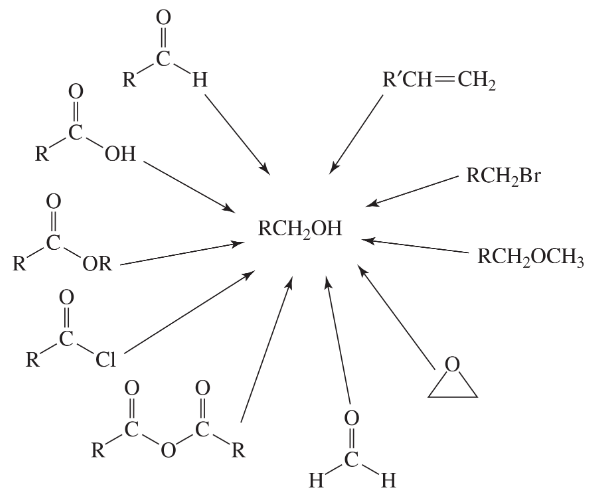
a. Show the reagents required to form the primary alcohol in each of the following reactions.
Verified step by step guidance
1
Identify the target compound: The primary alcohol (RCH2OH) is the desired product in each reaction. The goal is to determine the reagents required to convert the given starting materials into this alcohol.
For aldehydes (RCHO): Use a reducing agent such as sodium borohydride (NaBH4) or lithium aluminum hydride (LiAlH4) to reduce the aldehyde to a primary alcohol. The reaction involves the addition of hydrogen to the carbonyl group.
For carboxylic acids (RCOOH): Use a strong reducing agent like lithium aluminum hydride (LiAlH4) to reduce the carboxylic acid to a primary alcohol. Note that NaBH4 is not effective for carboxylic acids.
For esters (RCOOR'): Use lithium aluminum hydride (LiAlH4) to reduce the ester to a primary alcohol. The reaction involves breaking the ester bond and forming the alcohol.
For alkyl halides (RCH2Br): Use a nucleophilic substitution reaction with hydroxide ions (OH-) or water (H2O) to replace the halide group with a hydroxyl group, forming the primary alcohol.
Verified video answer for a similar problem:
This video solution was recommended by our tutors as helpful for the problem above
Video duration:
5m
Play a video:
Was this helpful?
Key Concepts
Here are the essential concepts you must grasp in order to answer the question correctly.
Reagents for Alcohol Formation
To synthesize primary alcohols, specific reagents are required depending on the starting materials. Common reagents include reducing agents like lithium aluminum hydride (LiAlH4) or sodium borohydride (NaBH4) for reducing carbonyl compounds, and halogenated compounds can be converted to alcohols through nucleophilic substitution reactions.
Nucleophilic substitution is a fundamental reaction in organic chemistry where a nucleophile replaces a leaving group in a molecule. This process is crucial for converting alkyl halides or other electrophiles into alcohols, as the nucleophile (often hydroxide ion, OH-) attacks the carbon atom bonded to the leaving group, resulting in the formation of an alcohol.
Nucleophiles and Electrophiles can react in Substitution Reactions.
Reduction of Carbonyl Compounds
The reduction of carbonyl compounds (aldehydes and ketones) to primary alcohols is a key transformation in organic synthesis. This process involves the addition of hydrogen or hydride ions to the carbonyl carbon, effectively converting the carbonyl group (C=O) into a hydroxyl group (C-OH), thus forming an alcohol. Common reducing agents include NaBH4 and LiAlH4.