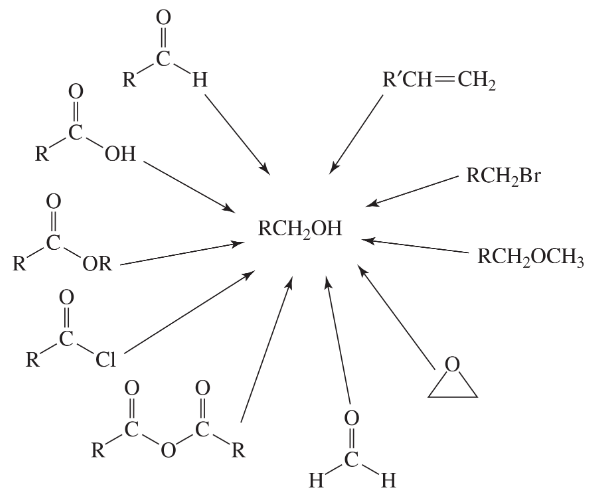
a. Show the reagents required to form the primary alcohol in each of the following reactions.
Verified step by step guidance
1
Step 1: Identify the starting material and the product. The starting material is an acyl chloride (RCOCl), and the product is a primary alcohol (RCH2OH). This indicates a reduction reaction.
Step 2: Recognize that acyl chlorides can be reduced to primary alcohols using specific reducing agents. Commonly used reagents for this transformation include lithium aluminum hydride (LiAlH4) or diborane (B2H6).
Step 3: Note that the reaction typically requires anhydrous conditions because LiAlH4 reacts violently with water. The solvent used is often an ether, such as diethyl ether or tetrahydrofuran (THF).
Step 4: Write the general reaction mechanism. The reducing agent donates hydride ions (H-) to the carbonyl carbon of the acyl chloride, breaking the C=O bond and forming an intermediate aldehyde. A second hydride transfer reduces the aldehyde to a primary alcohol.
Step 5: Summarize the reagents and conditions. To convert the given acyl chloride to the primary alcohol, use LiAlH4 in an anhydrous ether solvent, followed by careful quenching with water or dilute acid to complete the reaction.
Verified video answer for a similar problem:
This video solution was recommended by our tutors as helpful for the problem above
Video duration:
5m
Play a video:
Was this helpful?
Key Concepts
Here are the essential concepts you must grasp in order to answer the question correctly.
Reduction of Carbonyl Compounds
The conversion of carbonyl compounds (aldehydes or ketones) to alcohols is a fundamental reaction in organic chemistry known as reduction. This process typically involves the addition of hydrogen or a reducing agent, which donates electrons to the carbonyl carbon, resulting in the formation of an alcohol. In this case, the carbonyl compound is reduced to a primary alcohol.
Common reagents used for the reduction of carbonyl compounds to alcohols include lithium aluminum hydride (LiAlH4) and sodium borohydride (NaBH4). These reagents provide hydride ions (H-) that attack the electrophilic carbon of the carbonyl group, facilitating the conversion to an alcohol. The choice of reagent can depend on the specific carbonyl compound and desired reaction conditions.
Primary alcohols are characterized by having the hydroxyl (-OH) group attached to a carbon atom that is bonded to only one other carbon atom. This structural feature influences their reactivity and properties, making them distinct from secondary and tertiary alcohols. Understanding the structure of primary alcohols is essential for predicting their behavior in chemical reactions, including oxidation and substitution.