Predict the products formed when m-cresol (m-methylphenol) reacts with (b) acetyl chloride,
Verified step by step guidance
1
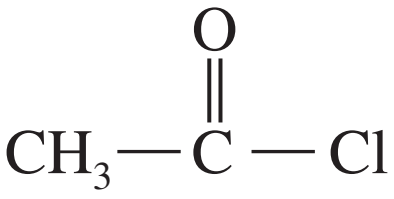
Step 1: Recognize the reactants involved in the reaction. m-Cresol (m-methylphenol) is a phenol derivative with a methyl group at the meta position relative to the hydroxyl group (-OH). Acetyl chloride (CH₃COCl) is an acyl halide, which is reactive towards nucleophiles like phenols.
Step 2: Understand the reaction mechanism. The hydroxyl group (-OH) on m-cresol is nucleophilic and can react with acetyl chloride via an acylation reaction. This is a typical example of electrophilic substitution where the phenol's hydroxyl group forms an ester bond with the acetyl group.
Step 3: Predict the product structure. The reaction will result in the formation of an ester, specifically m-methylphenyl acetate. The acetyl group (CH₃CO-) will replace the hydrogen atom of the hydroxyl group (-OH) on m-cresol.
Step 4: Consider the reaction conditions. This reaction typically requires a base like pyridine to neutralize the HCl byproduct formed during the acylation process and to facilitate the reaction.
Step 5: Write the chemical equation for the reaction. The reaction can be represented as:
Verified video answer for a similar problem:
This video solution was recommended by our tutors as helpful for the problem above
Video duration:
5m
Play a video:
Was this helpful?
Key Concepts
Here are the essential concepts you must grasp in order to answer the question correctly.
Electrophilic Aromatic Substitution
Electrophilic aromatic substitution (EAS) is a fundamental reaction in organic chemistry where an electrophile replaces a hydrogen atom on an aromatic ring. In the case of m-cresol reacting with acetyl chloride, the aromatic ring of m-cresol acts as a nucleophile, attacking the electrophilic carbon in acetyl chloride, leading to the formation of an acylated product.
Phenols, such as m-cresol, are more reactive than simple aromatic compounds due to the presence of the hydroxyl (-OH) group, which donates electron density to the ring. This increased electron density enhances the ring's nucleophilicity, making it more susceptible to electrophilic attack, such as that from acetyl chloride in this reaction.
Acyl chlorides are reactive compounds that contain a carbonyl group (C=O) bonded to a chlorine atom. They are commonly used in acylation reactions due to their ability to form stable products with nucleophiles, such as phenols. In this context, acetyl chloride will react with m-cresol to form an acetylated phenol, demonstrating the utility of acyl chlorides in organic synthesis.