What ratio of M, M + 2 , M + 4 and would you expect for 1,6-dibromohexane?
Verified step by step guidance
1
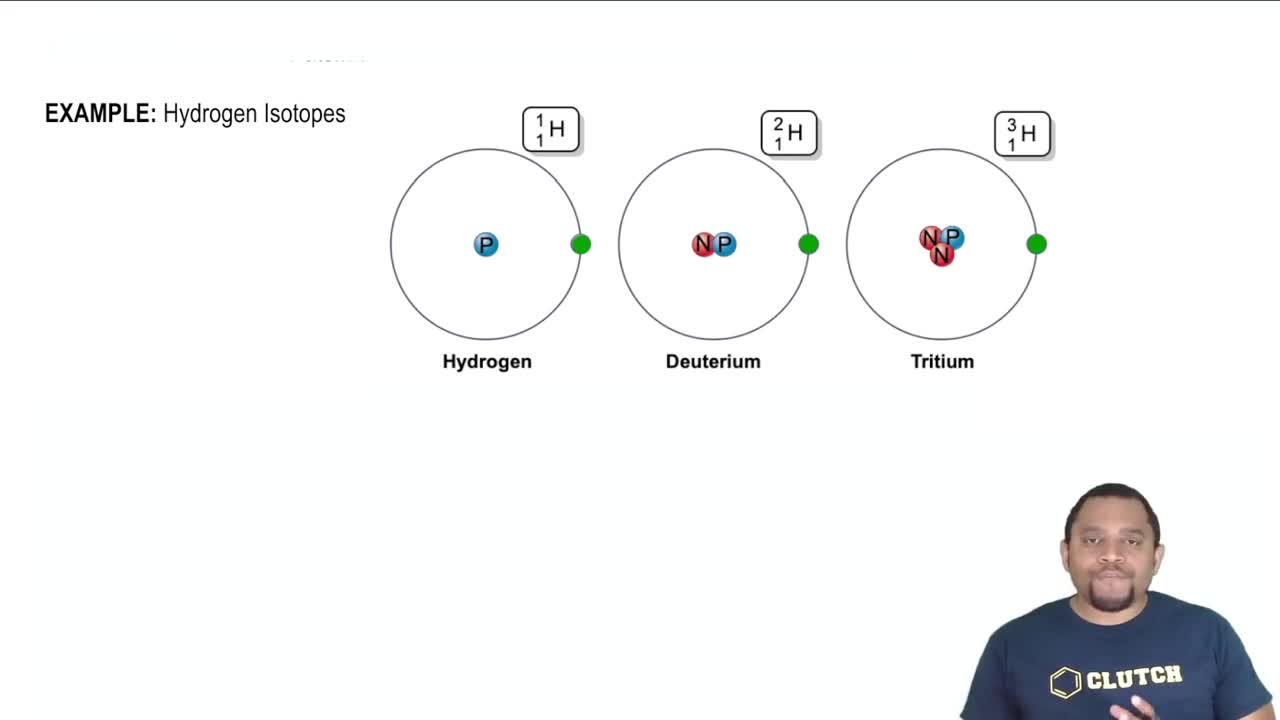
Understand the concept of isotopic distribution: The problem involves calculating the isotopic distribution of a molecule, specifically 1,6-dibromohexane. Bromine has two stable isotopes, Br-79 and Br-81, which will affect the mass spectrum of the compound.
Identify the molecular formula: 1,6-dibromohexane has the molecular formula C6H12Br2. This means it contains two bromine atoms, which can be either Br-79 or Br-81.
Calculate the possible mass combinations: The molecular ion peak (M) corresponds to the mass of the molecule with both bromine atoms as Br-79. The M+2 peak corresponds to one Br-79 and one Br-81, and the M+4 peak corresponds to both bromine atoms as Br-81.
Determine the relative abundance of isotopes: The natural abundance of Br-79 is approximately 50.7% and Br-81 is approximately 49.3%. Use these percentages to calculate the expected ratio of M, M+2, and M+4 peaks.
Apply the binomial distribution: Use the binomial distribution to calculate the probability of each isotopic combination. For two bromine atoms, the probabilities are: P(M) = (0.507)^2, P(M+2) = 2 * (0.507) * (0.493), and P(M+4) = (0.493)^2. This will give you the expected ratio of the peaks.
Verified video answer for a similar problem:
This video solution was recommended by our tutors as helpful for the problem above
Play a video:
Was this helpful?
Key Concepts
Here are the essential concepts you must grasp in order to answer the question correctly.
Isotopic Abundance
Isotopic abundance refers to the relative amount of each isotope of an element found in a natural sample. For bromine, the two main isotopes are Br-79 and Br-81, which occur in nearly equal abundance. This isotopic distribution is crucial for predicting the mass spectrum of compounds containing bromine, such as 1,6-dibromohexane.
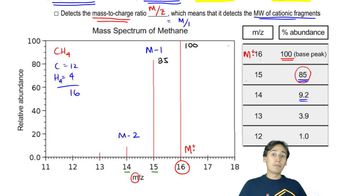
Mass spectrometry is an analytical technique used to measure the mass-to-charge ratio of ions. It helps in determining the molecular weight and structure of a compound. In the context of 1,6-dibromohexane, mass spectrometry can reveal the presence of isotopic peaks (M, M+2, M+4) due to the different combinations of bromine isotopes in the molecule.
The molecular ion peak (M) in a mass spectrum represents the ionized form of the entire molecule. For 1,6-dibromohexane, the M peak corresponds to the molecule containing two Br-79 isotopes. The M+2 and M+4 peaks arise from combinations of Br-79 and Br-81 isotopes, reflecting the isotopic pattern and helping to deduce the compound's structure.