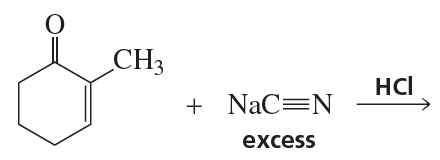
What are the products of the following reactions? g.
Verified step by step guidance
1
Step 1: Identify the functional groups in the starting material. The molecule shown is cyclopentenone, which contains both a ketone group (C=O) and a conjugated double bond in a five-membered ring.
Step 2: Recognize the reagents involved. Sodium cyanide (NaCN) is a source of cyanide ion (CN⁻), and hydrochloric acid (HCl) provides acidic conditions. This combination suggests a cyanohydrin formation reaction.
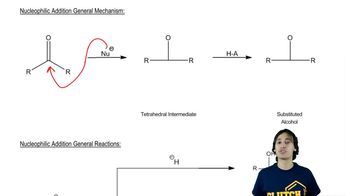
Step 3: Understand the mechanism. The cyanide ion (CN⁻) acts as a nucleophile and attacks the electrophilic carbon of the ketone group, forming a tetrahedral intermediate. The acidic conditions (HCl) then protonate the oxygen atom, stabilizing the product.
Step 4: Predict the product. The reaction results in the formation of a cyanohydrin, where the ketone group is converted into a hydroxyl group (-OH) and a cyano group (-CN) is added to the same carbon.
Step 5: Consider stereochemistry. If the reaction generates a chiral center, the product may exist as a racemic mixture (equal amounts of enantiomers) due to the non-stereoselective nature of the reaction.
Verified video answer for a similar problem:
This video solution was recommended by our tutors as helpful for the problem above
Video duration:
2m
Play a video:
Was this helpful?
Key Concepts
Here are the essential concepts you must grasp in order to answer the question correctly.
Nucleophilic Addition
Nucleophilic addition is a fundamental reaction mechanism in organic chemistry where a nucleophile attacks an electrophilic carbon atom, typically found in carbonyl compounds. In this case, the cyanide ion (CN-) from sodium cyanide (NaCN) acts as the nucleophile, attacking the carbonyl carbon of cyclopentanone, leading to the formation of a cyanohydrin.
Carbonyl compounds, characterized by the presence of a carbon-oxygen double bond (C=O), include aldehydes and ketones. Cyclopentanone is a cyclic ketone, and its reactivity is influenced by the electrophilic nature of the carbonyl carbon, making it susceptible to nucleophilic attack, which is crucial for understanding the reaction with NaCN.
Acid-base reactions involve the transfer of protons (H+) between reactants. In this reaction, HCl serves as an acid that can protonate the resulting cyanohydrin, stabilizing the product and influencing the reaction pathway. Understanding the role of acids in organic reactions is essential for predicting the final products and their stability.