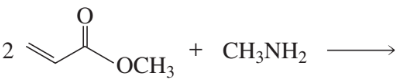
What are the products of the following reactions? j.
Verified step by step guidance
1
Step 1: Identify the reactants. Ethyl acrylate is an ester with an α,β-unsaturated carbonyl group, and ethanamine is a primary amine. This reaction involves nucleophilic addition or substitution.
Step 2: Recognize the reactivity of the α,β-unsaturated carbonyl group in ethyl acrylate. The double bond adjacent to the carbonyl group is electrophilic due to resonance stabilization, making it susceptible to nucleophilic attack.
Step 3: Ethanamine, as a nucleophile, will attack the electrophilic β-carbon of the α,β-unsaturated system in ethyl acrylate. This is a typical Michael addition reaction mechanism.
Step 4: After the nucleophilic attack, the intermediate formed undergoes proton transfer to stabilize the molecule. This results in the formation of a new bond between the amine and the β-carbon of ethyl acrylate.
Step 5: The final product is a β-amino ester, where the ethyl acrylate has been modified by the addition of ethanamine at the β-carbon position.
Verified video answer for a similar problem:
This video solution was recommended by our tutors as helpful for the problem above
Video duration:
5m
Play a video:
Was this helpful?
Key Concepts
Here are the essential concepts you must grasp in order to answer the question correctly.
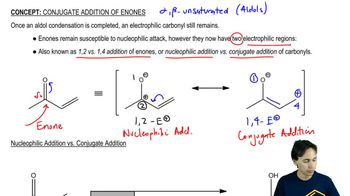
Conjugate Addition
Conjugate addition refers to the reaction where a nucleophile adds to the β-carbon of an α,β-unsaturated carbonyl compound. This process typically involves the attack of a nucleophile, such as an amine, on the double bond adjacent to the carbonyl group, leading to the formation of a new bond and a product that retains the carbonyl functionality.
α,β-Unsaturated carbonyl compounds, like ethyl acrylate, are highly reactive due to the presence of both a double bond and a carbonyl group. The electron-withdrawing nature of the carbonyl enhances the electrophilicity of the β-carbon, making it susceptible to nucleophilic attack, which is a key feature in many organic reactions, including conjugate additions.
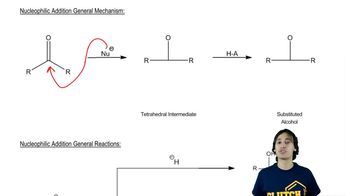
Nucleophiles are species that donate an electron pair to form a chemical bond in a reaction. In this context, ethanamine acts as a nucleophile, attacking the electrophilic β-carbon of ethyl acrylate. Understanding the nature of nucleophiles and their reactivity is crucial for predicting the products of organic reactions, particularly in conjugate addition scenarios.