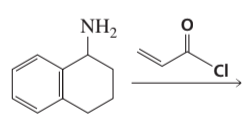
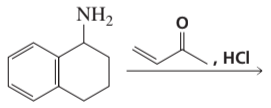
What is the product of each of the following reactions? c. d.
Verified step by step guidance
1
Step 1: Identify the functional groups in the reactants. The first reactant is an α,β-unsaturated ketone (contains a double bond conjugated to a ketone group). The second reactant is a cyclic amine (cyclohexylamine).
Step 2: Recognize the type of reaction. This is a nucleophilic addition reaction where the amine acts as a nucleophile and attacks the electrophilic carbon of the carbonyl group in the ketone.
Step 3: Protonation of the amine occurs due to the presence of HCl, forming an ammonium salt. This step stabilizes the intermediate formed during the reaction.
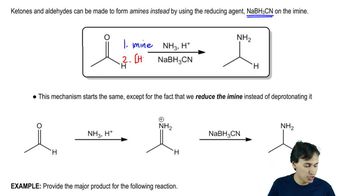
Step 4: The nucleophilic attack leads to the formation of an imine or enamine product, depending on the reaction conditions. The double bond in the α,β-unsaturated ketone may also participate in conjugate addition.
Step 5: Consider stereochemistry and regioselectivity. The product will depend on the specific conditions, but typically, the reaction proceeds to form a stable product with the amine group incorporated into the structure.
Verified video answer for a similar problem:
This video solution was recommended by our tutors as helpful for the problem above
Video duration:
5m
Play a video:
Was this helpful?
Key Concepts
Here are the essential concepts you must grasp in order to answer the question correctly.
Conjugate Addition
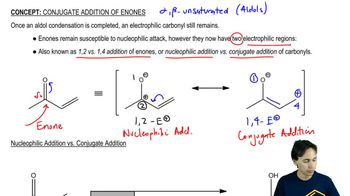
Conjugate addition refers to the nucleophilic addition of a reagent to a conjugated system, typically involving a carbonyl compound. In this reaction, the nucleophile attacks the β-carbon of the carbonyl, leading to the formation of a new bond. This process is crucial in organic synthesis, particularly in the formation of more complex molecules from simpler ones.
Carbonyl compounds contain a carbon atom double-bonded to an oxygen atom (C=O). They are key functional groups in organic chemistry, including aldehydes and ketones. Understanding their reactivity is essential, as they can undergo various reactions, including nucleophilic addition, which is central to the question at hand.
Amines are organic compounds derived from ammonia, where one or more hydrogen atoms are replaced by alkyl or aryl groups. They act as nucleophiles due to the lone pair of electrons on the nitrogen atom, allowing them to react with electrophiles such as carbonyl compounds. In the context of the reaction, the amine will add to the carbonyl, forming an intermediate that can be protonated by HCl.