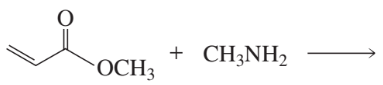
What are the products of the following reactions? i.
Verified step by step guidance
1
Step 1: Identify the reactants. Ethyl acrylate is an ester with an α,β-unsaturated carbonyl group, and ethanamine is a primary amine.
Step 2: Recognize the type of reaction. This is a nucleophilic addition reaction where the amine (ethanamine) acts as a nucleophile and attacks the electrophilic carbon of the α,β-unsaturated carbonyl group in ethyl acrylate.
Step 3: Analyze the mechanism. The lone pair of electrons on the nitrogen atom of ethanamine attacks the β-carbon of the double bond in ethyl acrylate, leading to the formation of a new bond. This breaks the π-bond of the alkene and forms an intermediate.
Step 4: Consider proton transfer. After the nucleophilic attack, proton transfer occurs to stabilize the intermediate, resulting in the formation of a β-amino ester.
Step 5: Write the product structure. The final product is a β-amino ester where the ethyl acrylate has been modified by the addition of ethanamine at the β-carbon position.
Verified video answer for a similar problem:
This video solution was recommended by our tutors as helpful for the problem above
Video duration:
4m
Play a video:
Was this helpful?
Key Concepts
Here are the essential concepts you must grasp in order to answer the question correctly.
Conjugate Addition
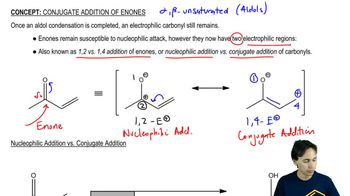
Conjugate addition refers to the reaction where a nucleophile adds to the β-carbon of an α,β-unsaturated carbonyl compound. In this case, ethanamine acts as the nucleophile, attacking the β-carbon of ethyl acrylate, leading to the formation of a new bond. This reaction is crucial in organic synthesis as it allows for the formation of more complex molecules.
In organic chemistry, nucleophiles are species that donate an electron pair to form a chemical bond, while electrophiles are electron-deficient species that accept an electron pair. In the given reaction, ethanamine (a nucleophile) attacks the electrophilic carbon of ethyl acrylate, facilitating the conjugate addition process. Understanding the roles of nucleophiles and electrophiles is essential for predicting reaction outcomes.
A reaction mechanism outlines the step-by-step process by which reactants transform into products. For the reaction between ethyl acrylate and ethanamine, the mechanism involves the nucleophilic attack of ethanamine on the β-carbon of the acrylate, followed by proton transfer and stabilization of the resulting intermediate. Grasping the mechanism is vital for understanding how and why specific products are formed.