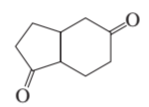
Show how the following compound can be prepared from starting materials that have no more than five carbons:
Verified step by step guidance
1
Step 1: Analyze the target compound. The structure contains a bicyclic ketone with two carbonyl groups. The compound has a total of 10 carbons, and the synthesis must start from materials with no more than five carbons.
Step 2: Identify key transformations. The compound can be synthesized using an aldol condensation reaction to form the bicyclic structure. This involves forming a new carbon-carbon bond between two smaller molecules.
Step 3: Select starting materials. Choose two molecules with no more than five carbons each that can undergo aldol condensation. For example, cyclopentanone (a five-carbon ketone) and acetaldehyde (a two-carbon aldehyde) can be used.
Step 4: Perform the aldol condensation. Under basic conditions, cyclopentanone can act as the nucleophile, and acetaldehyde can act as the electrophile. The enolate ion of cyclopentanone attacks the carbonyl carbon of acetaldehyde, forming a β-hydroxyketone intermediate.
Step 5: Complete the synthesis. Dehydrate the β-hydroxyketone intermediate to form the α,β-unsaturated ketone. Then, perform an intramolecular aldol condensation to form the bicyclic structure. Finally, oxidize the secondary alcohol to form the second ketone group.
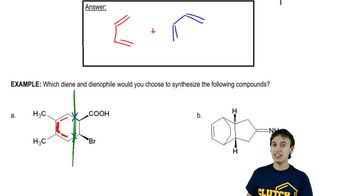
Verified video answer for a similar problem:
This video solution was recommended by our tutors as helpful for the problem above
Video duration:
8m
Play a video:
Was this helpful?
Key Concepts
Here are the essential concepts you must grasp in order to answer the question correctly.
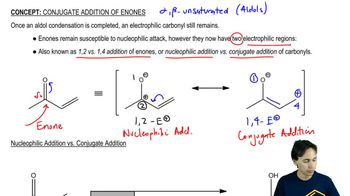
Conjugate Addition
Conjugate addition refers to the addition of a nucleophile to an α,β-unsaturated carbonyl compound. This reaction typically involves the nucleophile attacking the β-carbon, leading to the formation of a new bond. Understanding this mechanism is crucial for synthesizing compounds from simpler starting materials, as it allows for the construction of complex structures through strategic bond formation.
Retrosynthetic analysis is a problem-solving technique used in organic chemistry to deconstruct a target molecule into simpler precursor structures. By identifying key functional groups and potential reaction pathways, chemists can work backward from the desired compound to determine feasible starting materials. This approach is essential for planning synthetic routes that adhere to the constraint of using starting materials with no more than five carbons.
Functional group interconversion involves transforming one functional group into another through chemical reactions. This concept is vital for organic synthesis, as it allows chemists to modify starting materials to create desired intermediates or final products. Recognizing how to manipulate functional groups effectively is key to achieving the target compound from simpler carbon-based precursors.