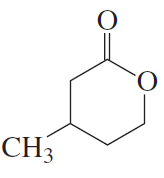
Step 1: Identify the parent structure. The molecule contains a six-membered ring with one oxygen atom incorporated into the ring, making it a cyclic ester (lactone). This indicates the parent structure is a δ-lactone.
Step 2: Determine the substituents. The ring has two substituents: a methyl group (-CH3) attached to one of the carbons in the ring and an ethyl group (-CH2CH3) attached to another carbon in the ring.
Step 3: Assign locants to the substituents. Number the ring starting from the carbonyl carbon (C=O) as position 1, and proceed around the ring to assign the lowest possible numbers to the substituents. The methyl group is at position 4, and the ethyl group is at position 6.
Step 4: Combine the substituents and parent name. The name will include the locants and names of the substituents followed by the parent lactone name. The substituents are listed alphabetically (ethyl before methyl).
Step 5: Finalize the name. The systematic name of the compound will be based on the IUPAC rules for naming lactones and cyclic esters, ensuring proper placement of locants and substituents.
Verified video answer for a similar problem:
This video solution was recommended by our tutors as helpful for the problem above
Video duration:
5m
Play a video:
Was this helpful?
Key Concepts
Here are the essential concepts you must grasp in order to answer the question correctly.
Ester Functional Group
Esters are organic compounds formed from the reaction of an alcohol and a carboxylic acid, characterized by the functional group -COO-. They typically have pleasant fruity odors and are commonly found in natural and synthetic substances. Understanding the structure of esters is crucial for naming them correctly.
The International Union of Pure and Applied Chemistry (IUPAC) nomenclature provides a systematic method for naming organic compounds. For esters, the name is derived from the alcohol and the carboxylic acid used in their formation, with the alkyl group from the alcohol named first, followed by the acid name modified to end in '-ate'.
Understanding structural representations, such as Lewis structures or condensed formulas, is essential in organic chemistry. They provide insight into the connectivity of atoms within a molecule, which is vital for identifying functional groups and determining the compound's name and properties.