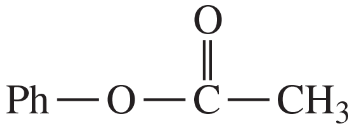
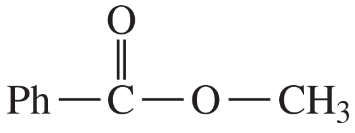
Give appropriate names for the following compounds: (e) (f)
Verified step by step guidance
1
Step 1: Analyze the structure of compound (e). The compound contains a phenyl group (Ph), an oxygen atom bonded to a carbonyl group (C=O), and a methyl group (CH₃). This structure corresponds to an ester functional group.
Step 2: For naming esters, the alkyl group attached to the oxygen atom is named first (in this case, 'methyl'), followed by the name of the acid-derived part. The acid-derived part is based on the phenyl group and the carbonyl group, which corresponds to benzoic acid. Replace 'acid' with 'ate' to form 'benzoate'.
Step 3: Combine the names to form the name of compound (e). The name is 'methyl benzoate'.
Step 4: Analyze the structure of compound (f). The compound contains a phenyl group (Ph) directly bonded to a carbonyl group (C=O), and an oxygen atom bonded to a methyl group (CH₃). This structure corresponds to an ester functional group as well.
Step 5: For naming compound (f), the alkyl group attached to the oxygen atom is named first (in this case, 'methyl'), followed by the name of the acid-derived part. The acid-derived part is based on the phenyl group and the carbonyl group, which corresponds to benzoyl. Combine the names to form 'methyl benzoate'.
Verified video answer for a similar problem:
This video solution was recommended by our tutors as helpful for the problem above
Video duration:
2m
Play a video:
Was this helpful?
Key Concepts
Here are the essential concepts you must grasp in order to answer the question correctly.
Ester Functional Group
An ester is a functional group characterized by the presence of a carbonyl group (C=O) adjacent to an ether group (R-O-R'). Esters are typically formed from the reaction of an alcohol and a carboxylic acid, and they are known for their pleasant fragrances. Understanding the structure of esters is crucial for naming them correctly, as the naming convention involves identifying the alkyl group from the alcohol and the acyl group from the acid.
The International Union of Pure and Applied Chemistry (IUPAC) provides systematic rules for naming chemical compounds. For esters, the name is derived from the alcohol and the carboxylic acid used in their formation. The alkyl part of the ester is named first, followed by the name of the acid with the suffix '-ate' replacing '-ic acid'. Familiarity with these conventions is essential for accurately naming organic compounds.
In organic chemistry, substituents are atoms or groups of atoms that replace hydrogen atoms in a hydrocarbon. The presence of different substituents can significantly influence the properties and reactivity of a compound. For esters, substituents such as phenyl or methoxy groups can affect the naming and the overall structure, making it important to identify and consider these groups when determining the compound's name.