The Reformatsky reaction is an addition reaction in which an organozinc reagent is used instead of a Grignard reagent to add to the carbonyl group of an aldehyde or a ketone. Because the organozinc reagent is less reactive than a Grignard reagent, a nucleophilic addition to the ester group does not occur. The organozinc reagent is prepared by treating an α-bromo ester with zinc. Describe how each of the following compounds can be prepared, using a Reformatsky reaction: a.
Verified step by step guidance
1
Step 1: Understand the Reformatsky reaction mechanism. The Reformatsky reaction involves the formation of an organozinc reagent from an α-bromo ester and zinc, which then reacts with a carbonyl compound (aldehyde or ketone) to form a β-hydroxy ester.
Step 2: Identify the target compound structure. Analyze the given compound structure to determine the necessary β-hydroxy ester product that needs to be synthesized using the Reformatsky reaction.
Step 3: Select the appropriate α-bromo ester. Based on the target compound, choose an α-bromo ester that will form the desired carbon skeleton after the Reformatsky reaction. Consider the carbon chain length and functional groups present in the target compound.
Step 4: Choose the carbonyl compound. Determine the aldehyde or ketone that will react with the organozinc reagent to form the β-hydroxy ester. Ensure that the carbonyl compound complements the α-bromo ester to achieve the desired product.
Step 5: Perform the Reformatsky reaction. Mix the α-bromo ester with zinc to form the organozinc reagent, then add the chosen carbonyl compound to the reaction mixture. Allow the reaction to proceed, forming the β-hydroxy ester, which can be further purified if necessary.
Verified video answer for a similar problem:
This video solution was recommended by our tutors as helpful for the problem above
Video duration:
2m
Play a video:
Was this helpful?
Key Concepts
Here are the essential concepts you must grasp in order to answer the question correctly.
Reformatsky Reaction
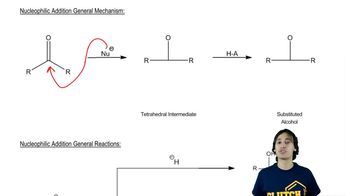
The Reformatsky reaction is a chemical reaction that involves the addition of an organozinc reagent to a carbonyl compound, typically an aldehyde or ketone. This reaction is notable for using organozinc reagents, which are less reactive than Grignard reagents, allowing for selective reactions without unwanted side reactions, such as nucleophilic addition to esters.
Organozinc reagents are organometallic compounds that contain a carbon-zinc bond. They are prepared by reacting zinc with organic halides, such as a-bromo esters. These reagents are valuable in organic synthesis due to their ability to act as nucleophiles in various reactions, including the Reformatsky reaction, where they selectively add to carbonyl groups.
Nucleophilic addition is a fundamental reaction mechanism in organic chemistry where a nucleophile attacks an electrophilic carbon atom, typically in a carbonyl group. In the context of the Reformatsky reaction, the organozinc reagent acts as the nucleophile, adding to the carbonyl carbon of aldehydes or ketones, leading to the formation of alcohols or other products, depending on the reaction conditions.